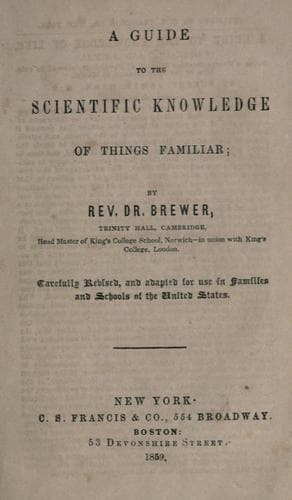
A Guide to the Scientific Knowledge of Things FamiliarBrewer, Ebenezer Cobham
Science
A Guide to the Scientific Knowledge of Things Familiar
Brewer, Ebenezer Cobham
Science -- Juvenile literature
Q. _How can a NAIL (beaten by a hammer) IGNITE a brimstone MATCH?_
A. As the particles of the nail are _compressed by the hammer_, it
cannot contain _so much heat as it did before_; so some of it _flies
out_ (as water flows from a sponge when it is squeezed).
Q. _Why does STRIKING a FLINT against a piece of STEEL produce a SPARK?_
A. The blow _condenses_ those parts of the flint and steel which strike
_together_, and squeezes out their latent heat.
Q. _How does this development of HEAT produce a SPARK?_
A. A very small fragment (either of the steel or flint) _is knocked off
red-hot_, and sets fire to the tinder on which it falls.
Q. _Why is it needful to keep BLOWING the TINDER with the breath?_
A. Because _blowing_ the tinder, drives the _oxygen of the air_ towards
it.
Q. _Where does the OXYGEN of the air COME FROM, which is blown to the
lighted tinder?_
A. The air itself is composed of two gases (_nitrogen and oxygen_) mixed
together.
(Every 5 lbs. of common air contain 4 lbs. of nitrogen, and 1 lb. of
oxygen.)
Q. _What is the good of BLOWING OXYGEN GAS to lighted tinder?_
A. Oxygen gas _supports combustion_; and lighted tinder is _quickened by
the breath_, in the same way as a dull fire is revived by a _pair of
bellows_.
Q. _Why do HORSES sometimes STRIKE FIRE with their FEET?_
A. When iron horse-shoes strike against the flint-stones of the road,
_very small fragments_ (either of the shoe or stones) are _knocked off
red-hot_, and look like sparks.
Q. _What makes these fragments RED-HOT?_
A. The percussion _condenses_ the part struck, _and squeezes out its
latent heat_.
CHAPTER VIII.
2.--FRICTION.
3.--CONDENSATION.
Q. _What is meant by FRICTION?_
A. The act of _rubbing two things together_; as the Indians rub two
pieces of _wood_ together to produce fire.
Q. _How do the Indians produce FIRE, by merely RUBBING TWO PIECES of dry
WOOD TOGETHER?_
A. They take a piece of dry wood (sharpened to a point), which they rub
quickly up and down a _flat piece_, till a _groove_ is made; and the
_saw-dust_ (collected in this groove) soon _catches fire_.
Q. _Why does the saw-dust of the WOOD CATCH FIRE by RUBBING?_
A. The _latent heat_ of the wood is _developed by friction_; because the
particles of the wood are _squeezed closer together_, and the heat pours
out, as water from a sponge.
(The best woods for this purpose are _box-wood_ against _mulberry_, or
_laurel_ against _poplar_ or _ivy_.)
Q. _Do not CARRIAGE WHEELS sometimes CATCH FIRE?_
A. Yes; if the wheels be _dry_,--or _fit too tightly_,--or _revolve very
rapidly_,--they often catch fire.
Q. _Why do wheels catch fire in such cases?_
A. The _friction_ of the wheels against _the axle-tree_ is so great,
that their _latent heat is disturbed_, and produces ignition.
Q. _What is the use of GREASING CART WHEELS?_
A. The grease _lessens the friction_; and (by diminishing the
_friction_) the latent heat is less disturbed.
Public-domain text, read in full here on John Shaqi.
Reviews
Reviews
No reviews yet
Be the first to share your thoughts on this work.
Join the Discussion
Join the discussion
Sign in to leave a comment or review.
Sign InorCreate an account