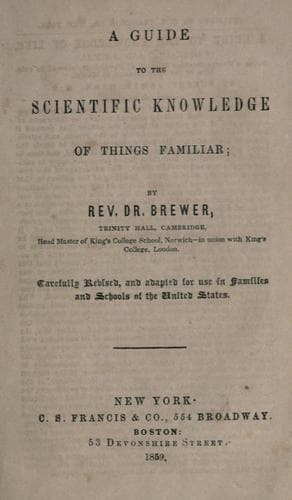
A Guide to the Scientific Knowledge of Things FamiliarBrewer, Ebenezer Cobham
Science
A Guide to the Scientific Knowledge of Things Familiar
Brewer, Ebenezer Cobham
Science -- Juvenile literature
A. The _dry skin_ prevents the _wind from penetrating to their body_;
and as the _fur_ contains a _quantity of air_ between its hairs (which
soon _becomes heated by the body_) the Laplander is clad in _a case of
hot air, impervious to the cold and wind_.
Q. _Why does a LINEN SHIRT feel COLDER than a COTTON ONE?_
A. _Linen is a much better conductor_ than cotton; and, therefore, (as
soon as it touches the body) _it more rapidly draws away the heat_, and
produces a sensation of cold.
Q. _Why is the FACE COOLED by wiping the temples with a fine CAMBRIC
HANDKERCHIEF?_
A. The fine fibres of the cambric have a _strong capillary attraction
for moisture_; and are _excellent conductors of heat_: thus the moisture
and heat are _both abstracted from the face_, and a sensation of
coolness is produced.
"Capillary attraction," i. e. _the attraction of a thread or hair_. The
wick of a candle is wet with grease, because the melted tallow runs up
the cotton from capillary attraction.
Q. _Why would not a COTTON handkerchief do as well?_
A. The coarse fibres of cotton have much less capillary attraction, and
are _nothing like such good conductors_ as linen: and, therefore, wiping
the face with a _cotton handkerchief_, increases the sensation of
warmth.
CHAPTER XIV.
2.--ABSORPTION OF HEAT.
Q. _What is the difference between CONDUCTING heat, and ABSORBING heat?_
A. To _conduct_ heat, is to _transmit it from one body to another_
through a conducting medium: to _absorb_ heat, is to _suck it up_, as a
sponge sucks up water.
Q. _Give me an example._
A. _Black cloth absorbs_, but does not _conduct heat_: thus, if black
cloth be laid in the sun, _it will absorb the rays_ very rapidly; but if
_one end of the black cloth_ be made hot, it would not _conduct the
heat_ to the _other_ end.
Q. _Are good CONDUCTORS of heat, good ABSORBERS also?_
A. No; every _good conductor of heat_ is a _bad absorber of it_; and _no
good absorber of heat_ can be a _good conductor_ also.
Q. _Is IRON a good ABSORBER of heat?_
A. No; _iron is a good conductor_, but a very _bad absorber_ of heat.
Q. _Why do the FENDER and FIRE-IRONS (which lie upon it) remain COLD,
although they are before a good fire?_
A. Because the metal fender and fire-irons have very _little capacity
for absorbing heat_; although they are soon made hot (by conduction),
when placed in _contact_ with the hot fire or stove.
Q. _Why does a KETTLE boil faster, when the bottom and back are COVERED
with SOOT?_
A. The _black soot absorbs heat_ very quickly from the fire, and the
metal _conducts it to the water_.
Q. _Why will not a NEW KETTLE boil so fast as an OLD one?_
A. Because the _bottom and sides_ of a new kettle are _clean and
bright_; but in an _old_ kettle _are covered with soot_.
Q. _Why would the KETTLE be SLOWER BOILING, if the BOTTOM and BACK were
CLEAN and bright?_
Public-domain text, read in full here on John Shaqi.
Reviews
Reviews
No reviews yet
Be the first to share your thoughts on this work.
Elsewhere in the archive
Join the Discussion
Join the discussion
Sign in to leave a comment or review.
Sign InorCreate an account