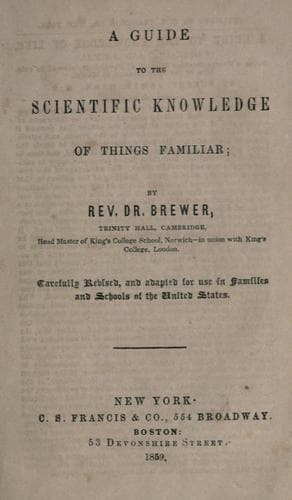
A Guide to the Scientific Knowledge of Things FamiliarBrewer, Ebenezer Cobham
Science
A Guide to the Scientific Knowledge of Things Familiar
Brewer, Ebenezer Cobham
Science -- Juvenile literature
Q. _Shew the WISDOM of GOD in making grass, the leaves of trees, and ALL
VEGETABLES, EXCELLENT RADIATORS of heat._
A. As vegetables _require much moisture_, and would often perish without
a plentiful deposit of dew, God wisely made them to _radiate heat
freely_, so as to _chill the vapour_ (which touches them) _into dew_.
Q. _Will polished METAL, smooth STONES, and woollen CLOTH, readily
collect DEW?_
A. No. While grass and the leaves of plants _are completely drenched
with dew_, a piece of _polished metal_, or of _woollen cloth_ (lying on
the same spot) will be _almost dry_.
Q. _Why would POLISHED METAL and WOOLLEN CLOTH be DRY, while grass and
leaves are drenched with DEW?_
A. Because the polished metal and woollen cloth _part with their heat so
slowly_, that the vapour of the air is _not chilled into dew_ as it
passes over them.
Q. _Why is a GRAVEL WALK almost DRY, when a grass plat is covered thick
with DEW?_
A. _Grass_, (_being a good radiator_) throws off its heat very _freely_;
but _gravel (being a very bad radiator)_ parts with its heat very
_reluctantly_.
Q. _Is that the reason why GRASS is SATURATED with DEW, and the GRAVEL
is NOT?_
A. Yes. When the vapour of warm air comes in contact with the _cold
grass_, it is instantly chilled into dew; but (as the gravel is _not so
cold as the grass_) the vapour of air is _not so freely condensed_ as it
passes over the gravel.
Q. _Why does DEW rarely fall upon hard ROCKS and BARREN lands?_
A. Rocks and barren lands are so _compact_ and _hard_, that they can
neither _absorb nor radiate much heat_; and (as their _temperature
varies but very little_) very little _dew_ distils upon them.
Q. _Why does DEW fall more abundantly on CULTIVATED soils, than on
BARREN lands?_
A. Because cultivated soils (being _loose and porous_) _absorb_ heat
freely during the day, and _radiate it_ by night; and (being _much
cooled by the rapid radiation of heat_) as the vapour of the air passes
over them, it is plentifully _condensed into dew_.
Q. _Shew the WISDOM of GOD in this arrangement._
A. Every plant and inch of land which _needs the moisture of dew_, is
adapted to _collect it_; but _not a single drop even of dew is wasted_,
where its refreshing moisture is _not required_.
Q. _Shew the WISDOM of GOD in making polished METAL and woollen CLOTH
BAD RADIATORS of heat._
A. If polished metal collected dew as easily as grass, it could _never
be kept dry_, and _free from rust_. Again, if woollen garments
collected dew as readily as the leaves of trees, we should be _often
soaking wet_, and subject to _constant colds_.
Q. _Shew how this affords a beautiful illustration of GIDEON'S MIRACLE,
recorded in the book of Judges, VI. 37, 38._
A. The _fleece of wool_ (which is a _very bad radiator_ of heat) was
_soaking wet_ with dew: when the _grass_ (which is a most _excellent
radiator_) was _quite dry_.
Q. _Was not this CONTRARY to the laws of NATURE?_
Public-domain text, read in full here on John Shaqi.
Reviews
Reviews
No reviews yet
Be the first to share your thoughts on this work.
Elsewhere in the archive
Join the Discussion
Join the discussion
Sign in to leave a comment or review.
Sign InorCreate an account