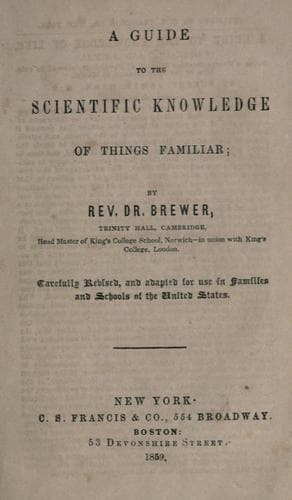
A Guide to the Scientific Knowledge of Things FamiliarBrewer, Ebenezer Cobham
Science
A Guide to the Scientific Knowledge of Things Familiar
Brewer, Ebenezer Cobham
Science -- Juvenile literature
A. Yes; and was, therefore, a plain _demonstration of the power of God_,
who could change the very _nature of things_ at his will.
Q. _Why do our CLOTHES FEEL DAMP, after walking in a fine evening in
SPRING or AUTUMN?_
A. Because the vapour (_condensed by the cold earth_) lights upon them,
like dew.
Q. _Why are WINDOWS often covered with thick MIST, and the frames wet
with standing WATER?_
A. The temperature of the _external air_ always _falls at sun-set_, and
_chills the window-glass_, with which it comes in contact.
Q. _How does this account for the MIST and WATER on a WINDOW?_
A. As the warm vapour of the room _touches the cold glass_, it is
_chilled_ and _condensed into mist_; and the mist (collecting into
drops) _rolls down the window-frame_ in little streams of water.
Q. _Does the GLASS of a window COOL down more RAPIDLY than the AIR of
the room itself?_
A. Yes; because the air is _kept warm by fires_, and the _animal heat_
of the people in the room; in consequence of which, the _air of a room
suffers very little diminution of heat_ from the setting of the sun.
Q. _Whence arises the VAPOUR of a ROOM?_
A. 1st--The very _air_ of the room _contains vapour_:
2ndly--The _breath_ and _insensible perspiration_ of the inmates
_increase_ this vapour: and
3rdly--_Hot dinners_, the _steam of tea_, &c. contribute to _increase it
still more_.
Q. _What is meant by "the INSENSIBLE PERSPIRATION?"_
A. From every part of the human body an _insensible and invisible
perspiration issues_ all night and day; not only in the hot weather of
_summer_, but also in the coldest day of _winter_.
Q. _If the perspiration be both INSENSIBLE and INVISIBLE, how is it
KNOWN that there IS any such perspiration?_
A. If you put your naked arm _into a clean dry glass cylinder_, the
_perspiration_ of your arm will soon _condense_ on the glass, like mist.
Q. _Why are CARRIAGE WINDOWS very SOON covered with thick MIST?_
A. The warm vapour of the carriage _is condensed the moment it touches
the cold glass_, and covers it over with a thick mist.
Q. _Why is the glass window COLD enough to condense the vapour of the
carriage?_
A. Because the _inside_ of the carriage is much _warmer_ than the
_outside_, and the glass window is made cold by contact with the
_external air_.
Q. _Where does the WARM vapour of the carriage come from?_
A. The warm _breath_ and _insensible perspiration_ of the persons riding
in the carriage, load the air of it with warm vapour.
Q. _What is the cause of the pretty FROST-WORK seen on bed-room WINDOWS
in winter-time?_
A. The _breath_ and _insensible perspiration_ of the sleeper (coming in
contact with the ice-cold window) is _frozen_ by the cold glass, and
forms those beautiful appearances seen in our bed-rooms in a winter
morning.
Q. _Why is the GLASS of a window colder than the WALLS of a room?_
A. Glass is a very _excellent radiator_; and, therefore, most _rapidly
parts with its heat_.
Public-domain text, read in full here on John Shaqi.
Reviews
Reviews
No reviews yet
Be the first to share your thoughts on this work.
Elsewhere in the archive
Join the Discussion
Join the discussion
Sign in to leave a comment or review.
Sign InorCreate an account