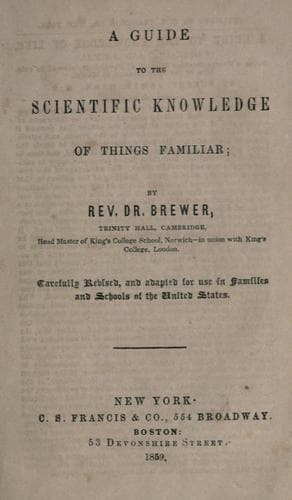
A Guide to the Scientific Knowledge of Things FamiliarBrewer, Ebenezer Cobham
Science
A Guide to the Scientific Knowledge of Things Familiar
Brewer, Ebenezer Cobham
Science -- Juvenile literature
Q. _Why is a TUMBLER of cold WATER made quite DULL with mist, when
brought into a room FULL of PEOPLE?_
A. Because the _hot vapour of the room_ (coming in contact with the cold
tumbler) _is condensed upon it_; and changes its invisible and gaseous
form for that of a _thick mist_.
Q. _Why is a GLASS made quite DULL, by laying a HOT HAND upon it?_
A. The _insensible perspiration_ of the hot hand is _condensed_ upon the
cold glass, and thus made perceptible.
Q. _Why are WINE-GLASSES made quite DULL when they are brought into a
room FULL of COMPANY?_
A. The _hot vapour of the room_ (coming in contact with the cold
wine-glasses) _is condensed_ upon them, and covers them with vapour like
dew.
Q. _Why does this misty appearance GO OFF after a little time?_
A. Because the glass becomes of the _same temperature_ as the _air of
the room_, and will no longer _chill the vapour_ which touches it, and
_condense it into mist_.
Q. _Why is a WINE-GLASS (brought out of a CELLAR into the AIR) covered
with a thick MIST in summer-time?_
A. The vapour of the hot air is _condensed_ by the cold glass, and
covers it as a thick mist.
Q. _Why does BREATHING on a GLASS make it quite DULL?_
A. Because the hot breath is _condensed_ by the cold glass; and,
therefore, covers it with a thick mist.
Q. _Why do WALLS stand thick with WET in a sudden THAW?_
A. The walls (being thick) cannot _change their temperature so fast_ as
the thin air can; and, therefore, they _retain their cold_ after the
thaw has set in.
Q. _How does RETAINING their COLD account for their being so WET?_
A. As the vapour of the warm air _touches the cold wall_, it is
_chilled_ and _condensed into water_, which _sticks to the wall_, and
sometimes trickles down in little streams.
Q. _Why does a thick WELL-BUILT HOUSE contract more DAMP of this kind,
than an ORDINARY one?_
A. Because the walls are much _thicker_; and (if the frost has
penetrated _far into the bricks_) it takes a long time to reduce them to
the _same temperature as the air_.
Q. _Why are BANISTERS, &c. DAMP after a THAW?_
A. The wooden banister (being made of some very close-grained, varnished
wood) cannot _change its temperature so fast_ as the air; and,
therefore, _remains cold_ some time after the thaw has set in.
Q. _How does THIS account for the BANISTERS being DAMP?_
A. The vapour of the warm air (_coming in contact with the cold
banister_) is _chilled_, and condensed into _water upon it_.
Q. _Why is our BREATH VISIBLE in WINTER and NOT in SUMMER?_
A. In _winter_ the coldness of the air condenses our breath into
_visible vapour_; but in _summer_ the air is _not cold enough_ to
condense it into visible vapour.
Q. _Why are our HAIR and the BRIM of our HAT often covered with little
drops of pearly DEW in winter-time?_
A. The breath (issuing from our mouth and nose) _is condensed into
drops_, as it comes in contact with our cold hair or hat; and (being
condensed) hangs there in little dew-drops.
Public-domain text, read in full here on John Shaqi.
Reviews
Reviews
No reviews yet
Be the first to share your thoughts on this work.
Elsewhere in the archive
Join the Discussion
Join the discussion
Sign in to leave a comment or review.
Sign InorCreate an account