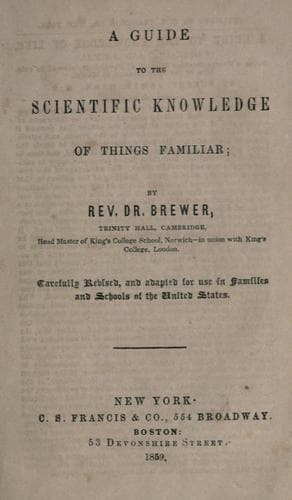
A Guide to the Scientific Knowledge of Things FamiliarBrewer, Ebenezer Cobham
Science
A Guide to the Scientific Knowledge of Things Familiar
Brewer, Ebenezer Cobham
Science -- Juvenile literature
A. It injures them very much, because it _fills the pores_ of the leaf
with a _thick clammy liquid_; and, therefore, prevents the leaf from
_transpiring and absorbing_.
Q. _What EFFECT has honey-dew upon the APPEARANCE of a leaf?_
A. After a little time, the leaf (being _smothered_ and _starved_)
begins to turn a _dingy yellow_.
Q. _Are not ANTS very FOND of HONEY-DEW?_
A. Yes; and they crawl up the loftiest trees, in order to obtain it.
Q. _What is the cause of MIST (or earth-fog)?_
A. If the _night has been very calm_, a _rapid_ radiation of heat has
taken place in the earth; in consequence of which, the _air_ (resting on
the earth) _is made so cold_, that its vapour is _chilled_, and
condensed into a thick mist.
Q. _Why does not the MIST become DEW?_
A. Because the chill of the air _is so rapid_, that vapour is condensed
_faster than it can be deposited_; and (covering the earth in a mist)
_prevents any further radiation of heat_ from the earth.
Q. _When the earth can no longer RADIATE heat upwards, does it continue
to CONDENSE the vapour of the air?_
A. No; the air (in contact with the earth) becomes about _equal in
temperature_ with the surface of the earth itself; for which reason, the
mist is _not condensed into dew_, but remains _floating above the earth_
as a thick cloud.
Q. _Why does this MIST seem to RISE HIGHER and HIGHER, and yet remain
quite as dense below as before?_
A. The air _resting on the earth_ is first chilled, and _chills the air_
resting on _it_; the air which touches _this new layer of mist_ being
also _condensed_, layer is added to layer; and the mist seems to be
_rising_, when (in fact) it is only _deepening_.
Q. _Why does MIST and DEW VANISH as the SUN rises?_
A. Because the condensed vapour is _again rarefied by the heat of the
sun_, and separated into invisible particles.
Q. _Why is a DEW-DROP ROUND?_
A. Because every part of the drop _is equally balanced_; and, therefore,
there is no cause why _one part_ of the drop _should be further from the
centre_ than _another_.
Q. _Why is the DEW-DROP on a broad leaf sometimes FLATTENED?_
A. Whenever two or more drops of dew _roll together_, they make one
large _spheroid_ (or flattened drop).
Q. _Why will DEW-DROPS ROLL ABOUT CABBAGE-PLANTS, POPPIES, &c. without
wetting the surface?_
A. The leaves of cabbages and poppies are _covered with a very fine
powder_; and the dew-drop rolls over this fine powder, as a drop of rain
_over dust_, without wetting the surface.
Q. _Why does not the drop of RAIN WET the DUST over which it rolls?_
A. Because it is driven from grain to grain by _capillary repulsion_.
Q. _Why does not the DEW-DROP WET the POWDER of the CABBAGE-plant?_
A. Because it is driven from grain to grain by _capillary repulsion_.
Q. _Why will DEW-DROPS ROLL over ROSES, &c. without wetting their
petals?_
A. The leaves of a rose _contain an essential oil_, which prevents them
from absorbing the dew immediately.
Public-domain text, read in full here on John Shaqi.
Reviews
Reviews
No reviews yet
Be the first to share your thoughts on this work.
Elsewhere in the archive
Join the Discussion
Join the discussion
Sign in to leave a comment or review.
Sign InorCreate an account