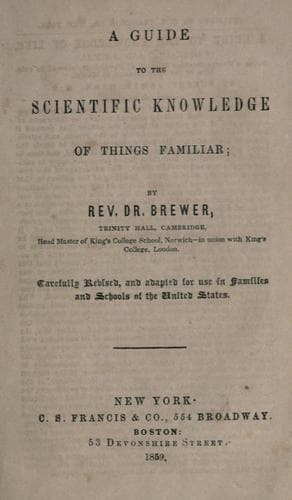
A Guide to the Scientific Knowledge of Things FamiliarBrewer, Ebenezer Cobham
Science
A Guide to the Scientific Knowledge of Things Familiar
Brewer, Ebenezer Cobham
Science -- Juvenile literature
Q. _Why can a SWAN or DUCK dive under water WITHOUT being WETTED?_
A. Because their feathers are covered _with an oily secretion_, which
repels the water.
Q. _What is the cause of MIST?_
A. When currents of air _from land_ mix with currents of air _from
water_, the currents _from the water are condensed into mist_ by the
colder currents _blowing from the land_.
Q. _Why are the currents of air from the LAND COLDER than those blowing
over WATER?_
A. Because the earth _radiates heat very freely_, and (being greatly
cooled down) _cools the air also_ which comes in contact with it.
Q. _Why is not the AIR, which passes over WATER, so COOL as that which
passes over LAND?_
A. Because _water does not cool down at sun-set_, so fast as the _land_
does; and, therefore, the air in contact with it is _warmer_.
Q. _Why does not WATER cool down so fast as LAND?_
A. 1st--Because the _surface_ of water is _perpetually changing_, and as
fast as _one_ surface is made cold, _another_ is presented: and
2ndly--The moment water is made cold _it sinks_, and _warmer portions of
water rise to occupy its place_: therefore, before the _surface of water
is cooled_, the _whole volume_ must be made cold; which is not the case
with land.
Q. _What is the cause of a "pea-soup" LONDON FOG?_
A. These fogs (which occur generally in the winter time) are occasioned
thus:--Some current of air (being suddenly _cooled_) _descends into the
warm streets_, preventing the rise of the smoke, and _forcing it back in
a mass_ towards the earth.
Q. _Why are there not ALWAYS FOGS every night?_
A. Because the air will always hold in solution a certain quantity of
vapour, (which varies according to its temperature): and when the air is
_not saturated with vapour_, it may be condensed without parting with
it.
Q. _Why are there EVER FOGS at night?_
A. If the air be _pretty well saturated with vapour_ during the day, as
soon as its capacity for holding vapour _is lessened by the cold night_,
it deposits some of the superabundant vapour in the form of dew or fog.
Q. _Why is there very OFTEN a fog over MARSHES and RIVERS at
night-time?_
A. The air of marshes is almost _always near saturation_; and,
therefore, the _least depression of temperature_, will compel it to
relinquish some part of its moisture in dew or fog.
Q. _What is the DIFFERENCE between DEW and RAIN?_
A. In _dew_, the condensation is made _near the earth's surface_:
In _rain_, the drops fall _from a considerable height_; but the cause of
both is the same, viz.--COLD _condensing the vapour of the air_, when
it is near the point of _saturation_.
Q. _Why does MIST and FOG VANISH at sunrise?_
A. Because the condensed particles are again _changed into invisible
vapour_, by the heat of the sun.
Q. _What is the difference between a MIST and FOG?_
A. MIST is generally applied to _vapours condensed on marshes, rivers_,
and _lakes_.
Public-domain text, read in full here on John Shaqi.
Reviews
Reviews
No reviews yet
Be the first to share your thoughts on this work.
Elsewhere in the archive
Join the Discussion
Join the discussion
Sign in to leave a comment or review.
Sign InorCreate an account