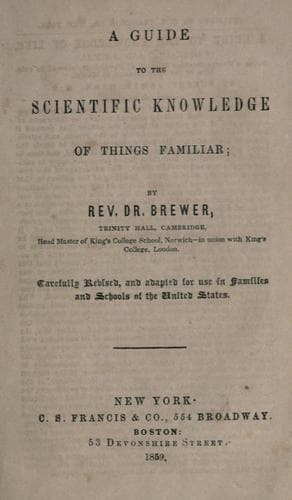
A Guide to the Scientific Knowledge of Things FamiliarBrewer, Ebenezer Cobham
Science
A Guide to the Scientific Knowledge of Things Familiar
Brewer, Ebenezer Cobham
Science -- Juvenile literature
Q. _Why are TOMB-STONES covered with HOAR-FROST, long after it has
melted from every object around?_
A. _White is a very bad absorbent of solar heat_; and, therefore, the
_white tomb-stone_ remains _too cold_ to thaw the frost congealed upon
its surface.
Q. _Why is there little or NO HOAR-FROST under SHRUBS and shadowy
TREES?_
A. 1st--Because the leafy shrubs and trees _arrest the process of
radiation_ from the earth: and
2ndly--Shrubs and trees _radiate a little heat_ towards the earth; and,
therefore, the _ground beneath_ is never _cold enough to congeal the
little dew_ which rests upon it.
Q. _What is the cause of that HOAR-FROST which arises from FROZEN FOG?_
A. The thick fog (which invested the earth during the night) is
condensed _by the cold frost_ of early morning, and _congealed upon
every object_ with which it comes in contact.
CHAPTER XVII.
5.--CONVECTION.
Q. _What is meant by the CONVECTION of HEAT?_
A. Heat communicated _by being carried_ to another thing or place; as
the hot water resting on the _bottom_ of a kettle, carries heat to the
water _through which it passes_. (_see p._ 246).
Q. _Are LIQUIDS good CONDUCTORS of heat?_
A. No; liquids are _bad conductors_; and are, therefore, made hot by
_convection_.
Q. _Why are LIQUIDS BAD CONDUCTORS of heat?_
A. Because heat _converts a liquid into steam_, and flies off with the
vapour, instead of being _conducted through the liquid_.
Q. _Explain how WATER is made HOT?_
A. The water _nearest the fire is first heated_, and (being heated)
_rises to the top;_ other cold water succeeds, is _also_ heated, and
rises in turn; and this interchange keeps going on, _till all the water
boils_.
Q. _Why is WATER in such continual FERMENT, when it is BOILING?_
A. This commotion is mainly produced by the _ascending and descending
currents_ of hot and cold water.
The escape of _air_ from the water contributes also to increase this
agitation.
Q. _How do these two currents PASS each other?_
A. The _hot ascending current_ passes close by the _metal sides_ of the
kettle; while the _cold descending current_ passes _down the centre_.
Q. _Why does BOILING WATER BUBBLE?_
A. The bubbles are _portions of steam_ (formed at the bottom of the
vessel) which _rise to the surface_, and escape into the air.
Q. _Why does a KETTLE RUN OVER, when the water BOILS?_
A. As the heat insinuates itself between the particles of water, _it
drives them asunder_; and (as the particles of water are _driven apart
from each other_) the _same_ vessel will no longer hold the expanded
water, and some runs over.
Q. _Why does a KETTLE SING, when it is ABOUT to BOIL?_
A. Water contains _a great deal of air_, which (being expanded by the
heat of the fire) escapes by fits _through the spout of the kettle_;
which sings in the same way as a trumpet does, when a person blows in
it.
Q. _Why does WATER BOIL?_
Public-domain text, read in full here on John Shaqi.
Reviews
Reviews
No reviews yet
Be the first to share your thoughts on this work.
Elsewhere in the archive
Join the Discussion
Join the discussion
Sign in to leave a comment or review.
Sign InorCreate an account