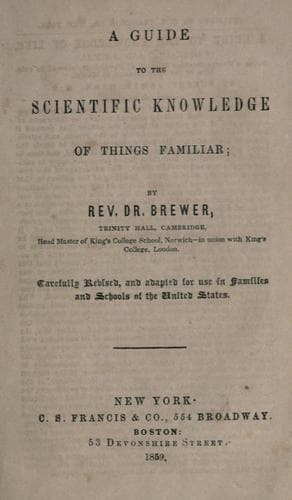
A Guide to the Scientific Knowledge of Things FamiliarBrewer, Ebenezer Cobham
Science
A Guide to the Scientific Knowledge of Things Familiar
Brewer, Ebenezer Cobham
Science -- Juvenile literature
A. Boiling is the effect of a _more violent escape of air_ from the
heated water; when, therefore, the air is _not permitted to escape_,
water will _never boil_.
Q. _Why is HEAT applied to the BOTTOM, and not to the top of a KETTLE?_
A. Because the heated water _always ascends to the surface_, heating the
water through which it passes: if, therefore, heat were applied to the
_top of a vessel_, the water _below the surface_ would _never be
heated_.
Q. _As the lower part of a GRATE is made RED-HOT by the fire ABOVE, why
would not the WATER boil, if fire were applied to the TOP?_
A. The _iron_ of a grate is an _excellent conductor_; and, therefore, if
_one_ part be heated, the heat is conducted to _every other part_: but
_water_ is a _very bad conductor_, and will not diffuse heat in a
similar way.
Q. _How do you know that WATER is a BAD CONDUCTOR of heat?_
A. When a blacksmith immerses his red-hot iron in a tank of water, the
water which _surrounds_ the red-hot iron is made _boiling hot_, but the
water _below_ the surface remains quite cold.
Q. _If you wish to COOL LIQUIDS, where should the cold be applied?_
A. To the _top of the liquid_; because the _cold_ portion will always
_descend_, and allow the warmer parts to come in contact with the
cooling substance.
Q. _Does BOILING water get hotter by being KEPT on the FIRE?_
A. No; not if the steam be suffered to escape.
Q. _Why does not boiling water get HOTTER, if the steam be suffered to
ESCAPE?_
A. Because _as fast as the water boils_, it is converted into _steam_;
and the steam _carries away_ the additional heat, as fast as it is
communicated.
Q. _Is STEAM visible or INVISIBLE?_
A. Steam is _invisible_; but when it comes in contact with the air
(being _condensed into small drops_) it instantly becomes visible.
Q. _How do you know that STEAM is INVISIBLE?_
A. If you look at the spout of a boiling kettle, you will find that the
steam (which issues from the spout) is always invisible _for about half
an inch_; after which, _it becomes visible_.
Q. _Why is the steam INVISIBLE for only HALF AN INCH, and not either all
INVISIBLE or all VISIBLE?_
A. The air is not able to condense the steam as it first issues from the
spout, but when it _spreads_ and comes in contact with a larger volume
of air, the _invisible steam_ is readily condensed into _visible drops_.
Q. _Why is our BREATH VISIBLE in winter-time?_
A. Because _it is condensed by the cold air_ into small drops, which are
visible to the eye.
Q. _Why do STEAM-ENGINES sometimes BURST?_
A. Steam is very _elastic_; and this elasticity increases in a greater
proportion than the heat which produces it; unless, therefore, some
_vent_ be freely allowed, the steam heaves and swells, till it bursts
the vessel which confined it.
Q. _What BECOMES of the steam, after it has been condensed?_
A. It is _dissolved by the air_, and forms a part of its invisible
vapour.
Q. _Is AIR a good CONDUCTOR?_
Public-domain text, read in full here on John Shaqi.
Reviews
Reviews
No reviews yet
Be the first to share your thoughts on this work.
Elsewhere in the archive
Join the Discussion
Join the discussion
Sign in to leave a comment or review.
Sign InorCreate an account