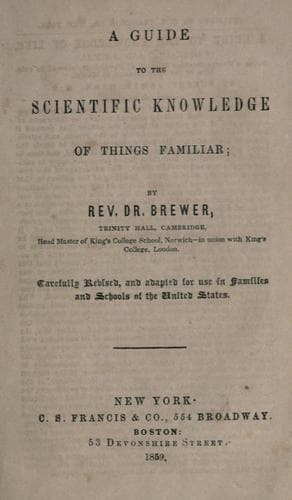
A Guide to the Scientific Knowledge of Things FamiliarBrewer, Ebenezer Cobham
Science
A Guide to the Scientific Knowledge of Things Familiar
Brewer, Ebenezer Cobham
Science -- Juvenile literature
A. No; _air is a very bad conductor_, and is heated (like water) _by
convection_.
Q. _How is a ROOM WARMED by a STOVE?_
A. The air _nearest the fire_ is made hot _first_; _the cold air
descends_, is heated also, and rises in turn; and this goes on, _till
all the air of the room is warmed_.
Q. _Why are FIRES placed on the FLOOR of a room, and not towards the
CEILING?_
A. As heated air always _ascends_, if the fire were not _near the
floor_, the lower part of the air (which we want to be the warmest)
would never be benefited by the fire at all.
Q. _If you take a POKER out of the fire, and hold the HOT END DOWNWARDS,
why is the HANDLE so intensely HOT?_
A. Because the hot end of the poker _heats the air around it_, and this
hot air (in its ascent) _scorches the poker_, and the _hand which holds
it_.
Q. _How should a RED-HOT POKER be carried so as not to BURN our
fingers?_
A. With the hot end _upwards_; because then the air (heated by the
poker) _would not pass over our hand_ to scorch it.
Q. _Why is a POKER (resting on the FENDER) COLD; but if it leans against
the STOVE, intensely warm?_
A. The poker is an _excellent conductor_; while, therefore, it rests
against the hot stove, the heat of the stove is _conducted into the
poker_; but when it _rests on the fender_, it does not come in _contact
with the hot stove_.
Q. _Why does it feel so COLD, when it rests on the FENDER?_
A. Not being so warm as our hand, it _imbibes the heat from it_ with
such _rapidity_, that our loss of heat is _palpable_, and produces the
sensation of coldness.
Q. _Why are FLUES (which are carried through a church or room) always
BLACKENED with BLACK LEAD?_
A. In order that the heat of the flue _may be more readily diffused_
throughout the room. Black lead radiates heat more freely than any other
known substance.
Q. _Why do country people touch the thick end of an EGG with their
TONGUE, to know if it be STALE or not?_
A. The thick end of an egg always contains _a little air_ (between the
shell and the white); but, when the egg is stale, _the white shrinks_,
and the air expands.
Q. _How can the TONGUE tell from this, whether the egg be STALE or FRESH
laid?_
A. As air is a _very bad conductor_, if the egg be _stale_, it will feel
much _warmer to the tongue_, than if it be new-laid.
Q. _Why will the big end of an egg feel WARMER to the tongue, because it
contains more AIR?_
A. As air is a _bad conductor_, it will draw off the heat of the tongue
_very slowly_, and, therefore, _appear warm_; but when there is only a
_very little air in the egg_ (as the _white_ is a pretty good
conductor), the heat of the tongue will be _more rapidly_ drawn off, and
the egg _appear colder_.
Q. _Why is the large END of an EGG CRACKED, when put into a saucepan to
boil?_
A. _To let the air out_; if the large end were _not cracked_, the air
(expanded by the heat) _would enter the white of the egg_, and give it
an _offensive taste_.
PART II.
AIR.
Public-domain text, read in full here on John Shaqi.
Reviews
Reviews
No reviews yet
Be the first to share your thoughts on this work.
Elsewhere in the archive
Join the Discussion
Join the discussion
Sign in to leave a comment or review.
Sign InorCreate an account