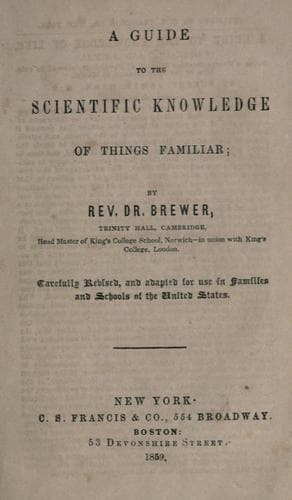
A Guide to the Scientific Knowledge of Things FamiliarBrewer, Ebenezer Cobham
Science
A Guide to the Scientific Knowledge of Things Familiar
Brewer, Ebenezer Cobham
Science -- Juvenile literature
A. The ear is fitted with a small membrane called _the drum_ (or
tympanum), through which the dense air bursts, and the rupture very
often _produces incurable deafness_.
Q. _Why do our CORNS ache just previous to RAIN?_
A. Previous to rain, the density of air is greatly lowered (as every one
knows from the fall of the barometer); in consequence of an unequal
pressure, _our feet swell_; but the hard corn, _not being elastic_, is
painfully stretched and pressed.
(Some of this pain is due to electricity.)
Q. _Why do CELLARS feel WARM in WINTER?_
A. As the external air has not free access into cellars, they remain at
a _pretty even temperature_, which (in winter time) is about 10 degrees
_warmer_ than the external air.
Q. _Why do CELLARS feel COLD in SUMMER time?_
A. As the external air has not free access into cellars, they remain at
a _pretty even temperature_, which (in summer time) is about 10 degrees
_colder_ than the external air.
Q. _Why does lightning strike the OAK-tree more frequently than any
OTHER tree?_
A. 1st--Because the _grain of the oak, being closer_ than that of any
other tree, renders it a better conductor: and
2ndly--The _sap_ of the oak contains a _large quantity of iron_ in
solution, which is a most admirable conductor of lightning.
Q. _Why does AIR rust IRON?_
A. The _oxygen of the air_ combines with the _surface of the iron_, and
produces _oxide of iron_, which is generally called rust.
This rust is a species of combustion.
Q. _Why does hot iron SCALE and PEEL off, when struck with a HAMMER?_
A. The _oxygen of the air_ very readily unites with _the surface of the
hot iron_, and forms a metallic oxide (or rust) which scales off when
struck with a hammer.
Q. _Does iron RUST in DRY air?_
A. No; iron undergoes no change in dry air.
Q. _Why do STOVES and FIRE-IRONS become RUSTY, in rooms which are not
OCCUPIED?_
A. Because the air is damp; and moist air _oxidizes_ (or rusts) iron and
steel.
Q. _In what part of the year is it most difficult to keep STOVES and
FIRE-IRONS BRIGHT?_
A. In _autumn and winter_; because the capacity of the air for holding
water _being on the decrease_, its vapour is deposited on every-thing
with which it comes in contact.
Q. _Why does GREASING iron prevent its becoming RUSTY?_
A. Because _grease_ prevents the humidity of air from coming in contact
with the _surface of the iron_.
Q. _Why do not STOVES rust so frequently as POKERS and TONGS?_
A. Because stoves are generally _covered with plumbago_, or black lead.
Q. _What is plumbago, or black lead?_
A. A mixture of charcoal and iron filings.
A most excellent varnish to prevent rust is made of 1 pint of fat oil
varnish, mixed with 5 pints of highly rectified spirits of turpentine,
rubbed on the iron or steel with a piece of sponge. This varnish may be
applied to bright stoves and even mathematical instruments, without
injuring their delicate polish.
Public-domain text, read in full here on John Shaqi.
Reviews
Reviews
No reviews yet
Be the first to share your thoughts on this work.
Elsewhere in the archive
Join the Discussion
Join the discussion
Sign in to leave a comment or review.
Sign InorCreate an account