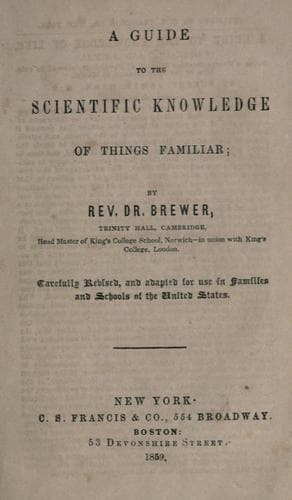
A Guide to the Scientific Knowledge of Things FamiliarBrewer, Ebenezer Cobham
Science
A Guide to the Scientific Knowledge of Things Familiar
Brewer, Ebenezer Cobham
Science -- Juvenile literature
Q. _Why does ornamental STEEL (of a purple or LILAC colour) rust more
readily than polished WHITE steel?_
A. Because the lilac tinge is produced by _partial oxidation_; and the
process which forms rust has, therefore, _already_ commenced.
Q. _How can lilac STEEL be kept FREE from RUST?_
A. By keeping it in a very _dry place_; for then no additional oxygen
will come in contact with it, to increase its amount of rust.
Q. _Do any OTHER metals (besides iron) combine rapidly with oxygen?_
A. Yes; copper, lead, mercury, and even silver to some extent.
Q. _Why does COPPER TARNISH?_
A. The tarnish of copper is caused by its _oxidation_; that is, the
oxygen of the air combines with the surface of the copper, and instead
of _rusting it_, covers it with a _dark tarnish_.
Q. _Why does LEAD lose its BRIGHTNESS, and become DULL and of a DARKER
hue, by being exposed to the air?_
A. The vapour of the air combines with the lead, and _oxidizes its
surface_; but instead of becoming _rusty_, the surface becomes _dull_,
and of a _darker colour_.
Q. _Why is it difficult to keep SILVER BRIGHT?_
A. Because the vapour of the air oxidizes its surface, and _tarnishes_
it.
Q. _Why do silver TEA-POTS and SPOONS tarnish more quickly than silver
ore or bullion?_
A. Because alloy (of some _baser_ metal) is used to make it more _hard
and lasting_; and this _alloy_ oxidizes more quickly than silver itself.
Q. _Why does GERMAN silver turn a dingy yellow in a few hours?_
A. German silver has a great affinity for oxygen, and shows its
oxidation by a _sickly yellow tarnish_, instead of rust.
Q. _If quicksilver (or mercury) is tarnished like copper and lead,--Why
does it preserve its BRILLIANCY in BAROMETERS and THERMOMETERS?_
A. Because _air_ is excluded from it, and no moisture comes in contact
with it to _oxidize_ (or _tarnish_ it).
Q. _Is GOLD affected by the atmosphere?_
A. Not readily: gold will never combine with oxygen of itself, (or
without aid).
Q. _Which of the METALS is capable of resisting oxidation altogether?_
A. Plat'inum; in consequence of which, the graduated arcs of delicate
instruments for observation are made of plat'inum instead of any _other_
metal.
Q. _Why is PLAT'INUM used for the graduated arcs of delicate
mathematical instruments, instead of any other metal?_
A. Because it will never oxidize; but retain its _bright surface_ in all
weathers free from both _rust and tarnish_.
Q. _Before plat'inum was discovered, which of the metals was employed
for the same purpose?_
A. Gold.
Platinum, (a white metal), so called from "plata," the Spanish word for
_silver_. It was first introduced into England by Mr. Wood, (A. D. 1749)
from South America.
Q. _For what other SCIENTIFIC purposes is PLAT'INUM now used?_
A. For crucibles in which _acids_ are employed, and for galvanic
batteries.
Q. _Why are CRUCIBLES (in which acids are employed) made of PLAT'INUM?_
Public-domain text, read in full here on John Shaqi.
Reviews
Reviews
No reviews yet
Be the first to share your thoughts on this work.
Elsewhere in the archive
Join the Discussion
Join the discussion
Sign in to leave a comment or review.
Sign InorCreate an account