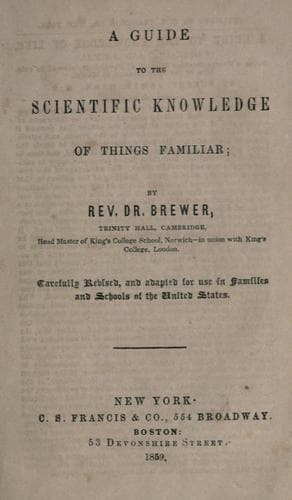
A Guide to the Scientific Knowledge of Things FamiliarBrewer, Ebenezer Cobham
Science
A Guide to the Scientific Knowledge of Things Familiar
Brewer, Ebenezer Cobham
Science -- Juvenile literature
A. Because the _candle will be extinguished_, if the mine contains
carbonic acid gas: but if the candle is _not extinguished_, the mine is
_safe_, and the man may fearlessly descend.
Q. _Why are PERSONS sometimes KILLED, by leaning over BEER VATS?_
A. Vats (where beer has been made) contain a _large quantity of carbonic
acid gas_, produced by the "vinous fermentation" of the beer; and when a
man incautiously _leans over a beer vat_, and inhales the carbonic acid,
he is immediately _killed_ thereby.
Q. _Why are PERSONS often KILLED, who enter BEER VATS to clean them?_
A. Carbonic acid (being _heavier than atmospheric air_) often rests upon
the _bottom of a vat_: when, therefore, a person enters the vat, and
_stoops to clean the bottom_, he inhales the pernicious gas, which
_kills_ him.
Q. _Why are the JUNGLES of Jarva and Hindostan so FATAL to life?_
A. Because vast quantities of _carbonic acid_ are thrown off by decaying
_vegetables_; and (as the wind cannot penetrate the thick brushwood to
blow it away) _it settles there_, and destroys animal life.
Q. _Why are PERSONS sometimes KILLED by having a CHARCOAL FIRE in their
bed-rooms?_
A. When charcoal is burned, the _carbon of the charcoal_ unites with the
_oxygen of the air_, and forms _carbonic acid gas_, which is a narcotic
poison.
Q. _Why does the carbonic acid gas of a CHARCOAL FIRE RISE and DISPERSE
itself about the room; whereas the carbonic acid gas of a BEER VAT
SETTLES near the FLOOR?_
A. The carbonic acid gas of a charcoal fire _is heated_ by the
_combustion of the fuel_, and rises; but the carbonic acid gas of a beer
vat is _not_ heated, and, therefore, rests on the _bottom of the vat_.
Q. _Why do persons throw LIME into BINS to PREVENT their offensive
SMELL, in summer time?_
A. Bins contain large quantities of _carbonic acid gas_, which readily
_combines with lime_, and produces "_carbonate of lime_," which is
entirely free from all offensive odour.
Q. _Why do persons throw LIME into SEWERS in summer time?_
A. Sewers (like bins) contain large quantities of _carbonic acid_, which
readily _combines with lime_, and produces _carbonate of lime_; and thus
the offensive gas of the sewer is neutralized.
Q. _Can carbonic acid be removed in any way BESIDES by LIME?_
A. Yes; _water_ thrown into a pit will disperse the carbonic acid.
Q. _What effect has WATER on CARBONIC ACID GAS?_
A. Water (under _pressure_) _absorbs_ carbonic acid gas; and _parts_
with it (when the _pressure is removed_) in the form of EFFERVESCENCE.
Q. _Why does AERATED WATER effervesce, when the CORK is removed?_
A. While the _cork was fastened down_, the water _absorbed_ the carbonic
acid; but the moment _the pressure is removed_ (by taking out the cork)
the gas is given out with _effervescence_.
Q. _Why does SODA WATER effervesce?_
A. Soda water contains 8 times its own bulk of carbonic acid gas, which
makes its escape in _effervescence_, the moment that the _cork is
removed_.
Public-domain text, read in full here on John Shaqi.
Reviews
Reviews
No reviews yet
Be the first to share your thoughts on this work.
Elsewhere in the archive
Join the Discussion
Join the discussion
Sign in to leave a comment or review.
Sign InorCreate an account