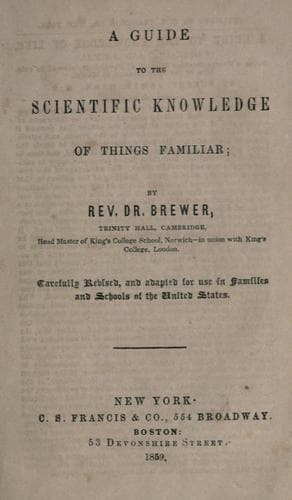
A Guide to the Scientific Knowledge of Things FamiliarBrewer, Ebenezer Cobham
Science
A Guide to the Scientific Knowledge of Things Familiar
Brewer, Ebenezer Cobham
Science -- Juvenile literature
A. Because the acid would act upon _other metals_, or upon _glass_, and
prevent the experimenter's success.
Q. _Which of the METALS have the GREATEST affinity to OXYGEN?_
A. Those called _potassium_ and _sodium_.
Potassium and sodium derive their names from potash and soda. Potassa is
the oxide of potassium; and soda is the oxide of sodium.
Q. _How is the affinity of potassium and sodium for oxygen shewn?_
A. They _decompose water_ the moment they are brought into contact with
it.
Q. _What effect has POTASSIUM on WATER?_
A. It _catches fire_ the moment it is thrown into water, and burns with
a vivid flame, which is still further increased by the combustion of
_hydrogen_ separated from the water.
(N.B. Water is composed of oxygen and hydrogen; and potassium separates
the two gases.)
Q. _What effect has SODIUM on WATER?_
A. It does _not take fire_ as potassium does, but undergoes very rapid
_oxidation_.
Q. _Is the FURR of KETTLES an oxide?_
A. No; the furr (or deposit of boiling water) is a precipitate of
_lime and mineral salt_, separated from the water by the process of
boiling.
Q. _Is not this FURR of boiling water often DANGEROUS?_
A. Yes; especially in _tubular boilers_, such as those employed in
railways.
Q. _Why is this FURR especially TROUBLESOME in RAILWAY engines?_
A. Because it is a _bad conductor of heat_; in consequence of which, it
hinders the evaporating effect of the fire, and prevents the economy of
fuel.
Q. _Why is this FURR especially DANGEROUS in RAILWAY engines?_
A. Because when it is deposited in the boilers, they are likely to
become _over-heated_; and then _explosion_ will take place from the
sudden generation of highly elastic steam.
Q. _Why cannot RAILWAY engines be fed with BRACKISH WATER?_
A. Because brackish water contains _mineral salt_, which makes a much
larger deposit of furr, than that which contains _only vegetable
matter_.
CHAPTER XIX.
CARBONIC ACID GAS.
Q. _What is CHOKE DAMP?_
A. _Carbonic acid gas_ accumulated at the bottom of wells and pits,
which renders them noxious, and often fatal.
Q. _Why is not this carbonic acid TAKEN UP by the AIR, and DIFFUSED, as
it is in cities?_
A. Because (being _heavier than common air_) it cannot _rise from the
well or pit_; and no wind can get to it to blow it away.
Q. _Is CARBONIC ACID WHOLESOME?_
A. No; it is _fatal to animal life_, when inhaled through the mouth;
acting on the stomach, _as a narcotic poison_ (i. e. a poison which
produces death from drowsiness).
Q. _How can any one KNOW, if a place be infested with CARBONIC ACID
GAS?_
A. If a pit or well contain carbonic acid, _a candle_ (let down into it)
_will be instantly extinguished_. The rule, therefore, is this--Where a
_candle will burn, a man can live_; but _what will extinguish a candle_,
will _also destroy life_.
Q. _Why does a MINER lower a CANDLE into a mine, before he descends?_
Public-domain text, read in full here on John Shaqi.
Reviews
Reviews
No reviews yet
Be the first to share your thoughts on this work.
Elsewhere in the archive
Join the Discussion
Join the discussion
Sign in to leave a comment or review.
Sign InorCreate an account