A Handbook of Some South Indian Grasses — John Shaqi
A Handbook of Some South Indian GrassesRangachari, K.
Science
A Handbook of Some South Indian Grasses
Rangachari, K.
Grasses -- India, South; Plants -- India, South
Produced by Suzanne Lybarger, John Hagerson, Juliet
Sutherland, Leonard Johnson and the Online Distributed
Proofreading Team at http://www.pgdp.net (This file was
produced from images generously made available by The
Internet Archive/Million Book Project)
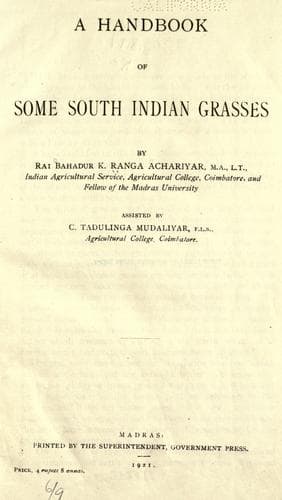
A HANDBOOK
OF
SOME SOUTH INDIAN GRASSES
BY
RAI BAHADUR K. RANGA ACHARIYAR, M.A., L.T.,
_Indian Agricultural Service, Agricultural College, Coimbatore, and
Fellow of the Madras University_
ASSISTED BY
C. TADULINGA MUDALIYAR, F.L.S.,
_Agricultural College, Coimbatore._
MADRAS:
PRINTED BY THE SUPERINTENDENT, GOVERNMENT PRESS.
1921
Price, 4 _rupees_ 8 _annas_
PREFACE
This book is intended to serve as a guide to the study of grasses of the
plains of South India. For the past few years I have been receiving
grasses for identification, almost every week, from the officers of the
Agricultural and Forest Departments and others interested in grasses.
The requirements of these men and the absence of a suitable book induced
me to write this book.
I have included in this book about one hundred grasses of wide
distribution in the plains of South India. Many of them occur also in
other parts of India. The rarer grasses of the plains and those growing
on the hills are omitted, with a view to deal with them separately.
The value of grasses can be realized from the fact that man can supply
all his needs from them alone, and their importance in agriculture is
very great, as the welfare of the cattle is dependent upon grasses.
Farmers, as a rule, take no interest in them, although profitable
agriculture is impossible without grasses. Very few of them can give the
names of at least half a dozen grasses growing on their land. They
neglect grasses, because they are common and are found everywhere. They
cannot discriminate between them. To a farmer "grass is grass" and that
is all he cares to trouble himself about. About grasses Robinson writes
"Grass is King. It rules and governs the world. It is the very
foundation of all commerce: without it the earth would be a barren
waste, and cotton, gold, and commerce all dead."
In the early days when the population was very much limited and when
land not brought under cultivation was extensive plenty of green grasses
was upon it and pastures were numerous. So the farmer paid no attention
to the grasses, and it did not matter much. But now, population has
increased, unoccupied land has decreased very much and the cattle have
increased in number. Consequently he has to pay more attention to
grasses.
Public-domain text, read in full here on John Shaqi.
Reviews
Reviews
No reviews yet
Be the first to share your thoughts on this work.
Join the Discussion
Join the discussion
Sign in to leave a comment or review.
Sign InorCreate an account