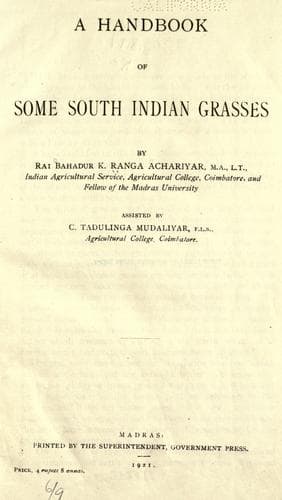
A Handbook of Some South Indian GrassesRangachari, K.
Science
A Handbook of Some South Indian Grasses
Rangachari, K.
Grasses -- India, South; Plants -- India, South
There are 6 or 7 glumes in the spikelet. The _first glume_ is
lanceolate, acute, softly hairy, usually 9-nerved, or varying from 7 to
12 (some nerves do not reach the apex), about 1/4 inch long. The _second
glume_ is similar to the first but a little longer and both the glumes
have broad hyaline margins. The _third glume_ is broadly orbicular,
concave, sub-chartaceous, 9-nerved, densely villous and with a tuft of
hairs at the base where it joins the rachilla, cleft into 9 awn-like
lobes, bisexual and paleate; the awns are alternately long and short,
subulate, plumose in the lower half and scabrid above, the palea is
oblong-ovate, sub-chartaceous, with two pubescent keels, bifid at the
apex, and with 3 purple anthers. The _ovary_ is ovoid or ovoid-oblong,
with two white stigmas. _Lodicules_ are two, small cuneate or quadrate.
Grain ovoid or ovoid-oblong. The _fourth_ _glume_ is similar to the
third glume but smaller, paleate with rudimentary anthers and two fleshy
lodicules. The _fifth_, _sixth_ and _seventh glumes_ are imperfect and
gradually decreasing in size, and with awns varying in number from 5 to
8, 3 to 5, and 1 to 3, respectively, minutely paleate or not.
This grass grows well in black cotton and rich loamy soils and is a
hardy one. Cattle seem to eat this grass.
_Distribution._--Fairly common in the plains in the Deccan districts and
in the Coromandel coast districts.
42. Eragrostis, _Beauv._
These are slender, glabrous, annual or perennial grasses. Stems are
usually erect or geniculately ascending, very rarely prostrate. Leaves
are narrow. Inflorescences are open or contracted panicles, rarely
spikes. Spikelets are usually strongly laterally compressed, 2, to
many-flowered and not articulate at the base; rachilla is tough and
persistent, jointed above the empty glumes and in some also between the
flowering glumes, not produced beyond the last glume. Glumes are many,
broad, obtuse, acute or mucronate, never awned, dorsally rounded and
keeled; the first and the second glumes are much shorter than the
spikelet, equal or unequal, empty, persistent or separately deciduous,
1-nerved or the second 3-nerved, usually membranous. Flowering glumes
are imbricating, at length deciduous from the rachilla, 3-nerved, all
bisexual or the uppermost and rarely the lowest imperfect, ovate to
lanceolate, membranous to chartaceous, usually glabrous, the lateral
nerves short not reaching the mid nerve; palea are broad, membranous,
deciduous with its glume or persistent on the rachilla with two ciliate
smooth or scabrid keels. Stamens are three rarely two. Ovary is glabrous
with two styles ending in plumose stigmas. Grain is minute, globose,
obgloboid or obovoid, free in the glume and the palea.
KEY TO THE SPECIES.
A. Spikelets panicled.
B. Rachilla of spikelets more or
less jointed and breaking up from
above downwards.
Panicle more or less contracted
and margin of flowering
glumes not ciliate.
Public-domain text, read in full here on John Shaqi.
Reviews
Reviews
No reviews yet
Be the first to share your thoughts on this work.
Elsewhere in the archive
Join the Discussion
Join the discussion
Sign in to leave a comment or review.
Sign InorCreate an account