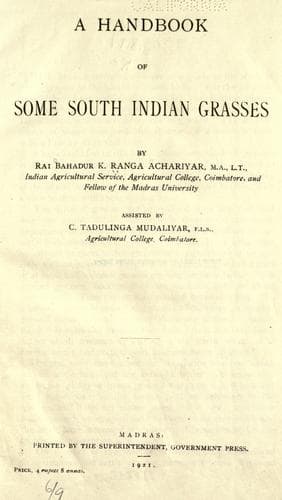
A Handbook of Some South Indian GrassesRangachari, K.
Science
A Handbook of Some South Indian Grasses
Rangachari, K.
Grasses -- India, South; Plants -- India, South
This is a floating aquatic grass. Stems are spongy, branching diffusely,
1 foot long, with feathery whorled roots in dense masses at the nodes;
branches are short, erect and leafy.
The _leaf-sheath_ is smooth, inflated, compressed, with ciliate margins.
The _ligule_ is a narrow membrane. _Nodes_ have whorls of roots.
The _leaf-blade_ is linear or ovate-lanceolate, obtuse, glabrous,
glaucous beneath, base rounded or subcordate, 1 to 3 inches long and 1/2
to 3/4 inch broad.
The _inflorescence_ is a panicle, 2 inches long and broad, somewhat
triangular in outline; the _rachis_ and the branches are stiff, slender
and smooth, the lower branches are a little deflexed.
[Illustration: Fig. 120.--Hygrorhiza aristata.
1. Branch; 2. part of a leaf with ligule; 3. spikelet; 4 and 5. glume
and its palea; 6. lodicules and ovary.]
The _spikelets_ are very narrow, sessile or pedicellate, articulated on
the pedicel, 1-flowered and 1-glumed. The _glume_ is about 3/8 inch long
(excluding the awn) and the awn is as long as the glume or slightly
longer, lanceolate, with five strong nerves and the lateral ones forming
thickened margins; the palea is as long as the glume. _Stamens_ are six
and _lodicules_ two.
Found in ponds and tanks.
_Distribution._--All over India and Ceylon.
13. Trachys, _Pers._
These are softly, villous, diffuse annual grasses. The inflorescence
consists of usually two (rarely three) divaricating spikes on a long
peduncle. The rachis is herbaceous, broad flexuous, jointed and bearing
at each joint a solitary globose cluster of two or three perfect
1-flowered glabrous spikelets surrounded by many short spinescent glumes
of imperfect ones. The perfect spikelets are 4-glumed and the glumes are
very unequal. The first glume is minute, tooth-like, nerveless. The
second glume is long, linear-lanceolate, membranous, very acute,
strongly 3- to 5-nerved. The third glume is the largest, obliquely
ovate, or obovate-oblong, cuspidately acuminate, rigidly coriaceous, 9-
to many-nerved, paleate or not, empty. The fourth glume is shorter and
narrower than the lower one, linear-oblong, acuminate, chartaceous,
smooth, dorsally convex, with incurved margins, bearing a bisexual
flower, paleate, palea is hyaline as long as the glume, and the margins
are inflexed below the middle. Lodicules are very minute or wanting.
There are three stamens. The styles are very long with slender stigmas,
exserted at the top of the glume. The grain is oblong, compressed, free
within the glume and its palea.
=Trachys mucronata, _Pers._=
This is a diffusely branching, softly villous annual grass. The stems
are many from the root, 16 to 18 inches long, ascending or decumbent and
prostrate, leafy, glabrous, rooting freely at the lower nodes,
especially when procumbent.
The _leaf-sheaths_ are loose, inflated, hairy or rarely glabrous. The
_ligule_ is a thin membrane, or a ridge of fine closely set hairs.
_Nodes_ are villous.
Public-domain text, read in full here on John Shaqi.
Reviews
Reviews
No reviews yet
Be the first to share your thoughts on this work.
Elsewhere in the archive
Join the Discussion
Join the discussion
Sign in to leave a comment or review.
Sign InorCreate an account