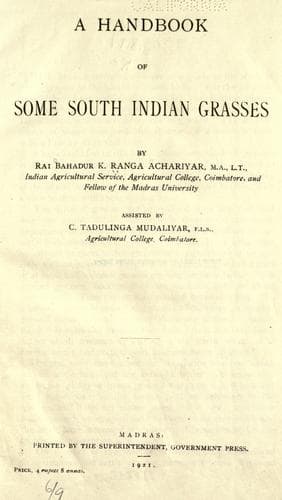
A Handbook of Some South Indian GrassesRangachari, K.
Science
A Handbook of Some South Indian Grasses
Rangachari, K.
Grasses -- India, South; Plants -- India, South
These are tall perennial marsh grasses. The inflorescence is usually a
more or less contracted panicle with very slender branches. The
spikelets are compressed and consist of only one glume bearing a perfect
flower. The solitary flowering glume is chartaceous, awnless, 3- to
5-nerved, the lateral nerves forming the thickened margin of the glume.
The palea is narrow, linear-lanceolate, as long as the glume, 3-nerved,
rigid, dorsally ciliate, and with hyaline margins. Lodicules are two.
Stamens are usually six in number. Styles are short, with plumose
stigmas and laterally exserted. Grain is ovoid or oblong, compressed,
free within the glume and its palea.
=Leersia hexandra, _Sw._=
This is a slender perennial marsh-grass with stems rooting in the mud
and with flexuous floating branches, sending up erect or ascending, weak
and slender leafy branches, 2 to 4 feet high.
[Illustration: Fig. 119.--Leersia hexandra.
1. Erect branch; 2 and 3. bits of leaves with ligules; 4 and 5.
spikelets; 6. ovary and lodicules.]
The _leaf-sheath_ is smooth, glabrous, with eciliate margins. The
_ligule_ is a short obliquely truncate or two-lobed membrane. _Nodes_
are hairy with deflexed hairs.
The _leaf-blade_ is flat, narrow, linear, tapering to a fine point,
suberect and rather rigid, glabrous and with a narrow base, varying in
length from 3 to 10 inches and 1/8 to 1/3 inch in breadth.
The _inflorescence_ is an oblong laxly branched, narrow pedunculate
panicle, 2 to 4 inches long.
The _spikelets_ are all 1-flowered and 1-glumed, articulate on the
pedicels above the rudimentary glumes, strongly laterally compressed.
The _glume_ is about 1/6 inch long, ovate-oblong, somewhat boat-shaped,
acute and shortly mucronate, strongly keeled, ciliate on the keel and
margins, 5-nerved, the lateral nerves forming a thickened margin;
_palea_ is as long as the glume, linear-lanceolate, subacute, rigid with
membranous margins. _Stamens_ are six and there are two small
_lodicules_. The first two glumes are reduced to an obscure hyaline rim.
This marsh-grass is found in marshy places such as ditches and channels
in paddy fields, ponds and tanks.
_Distribution._--It is found all over India and Ceylon; also in Africa,
America and Australia.
12. Hygrorhiza, _Nees._
These are floating glabrous grasses with stems diffusely branching and
profusely rooting at the nodes. The inflorescence is a panicle. The
spikelets are 1-flowered, with a solitary flowering glume only. The
flowering glume is awned, strongly 5-nerved, nerves scabrid and ciliate,
the lateral nerves being marginal. Palea is 3-nerved, narrow acuminate
with a ciliate keel. Lodicules are suborbicular. There are six stamens
with long slender anthers. Styles are free with plumose stigmas,
laterally exserted. Grain is oblong, narrowed at the base, obtuse, free
within the glume and its palea.
=Hygrorhiza aristata, _Nees._=
Public-domain text, read in full here on John Shaqi.
Reviews
Reviews
No reviews yet
Be the first to share your thoughts on this work.
Elsewhere in the archive
Join the Discussion
Join the discussion
Sign in to leave a comment or review.
Sign InorCreate an account