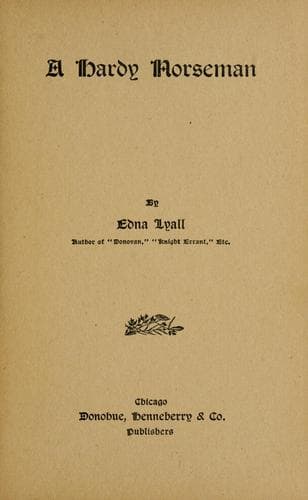
British -- Norway -- Fiction; Conduct of life -- Fiction; Norwegians -- England -- Fiction
“No one in absence of mind could deliberately have pinned the note in,”
he said. “Besides my head was perfectly clear, not even aching or
tired.”
“Quite so; I am glad that so far you own the truth,” said Mr. Horner.
“Make a free confession at once and we will not press the prosecution.
You yielded to a sudden temptation, and, as we all know, have special
reasons for needing money. Come, confess!”
“You are not bound to incriminate yourself,” said the detective, who, as
acting in a private capacity, was not bound to urge the prosecution.
“Still, what the gentleman suggests is by far the best course for you to
take. There’s not a jury in the land that would not give a verdict
against you.”
“I shall certainly not tell a lie to save open disgrace,” said Frithiof.
“The jury may say what it likes. God knows I am innocent.”
The tone in which he said the last words made Mr. Boniface look at him
more closely. Strangely enough it was in that moment of supreme
bitterness, when he fully realized the hopelessness of his position,
when one of his employers deemed him a madman and the other a thief,
then, when disgrace and ruin and utter misery stared him in the face,
that the faint glimpses of the Unseen, which, from time to time, had
dawned for him, broadened into full sunlight. For the first time in his
life he stood in close personal relationship with the Power in whom he
had always vaguely believed, the higher Presence became to him much more
real than men surrounding him with their pity and indignation and
contempt.
But Mr. Horner was not the sort of man to read faces, much less to read
hearts; the very emphasis with which Frithiof had spoken made him more
angry.
“Now I _know_ that you are lying!” he cried: “don’t add blasphemy to
your crime. You are the most irreligious fellow I ever came across—a man
who, to my certain knowledge, never attends any place of public worship,
and do you dare to call God to witness for you?”
Nothing but the strong consciousness of this new Presence kept Frithiof
from making a sharp retort. But a great calmness had come over him, and
his tone might have convinced even Mr. Horner had he not been so full of
prejudice. “God knows I am innocent,” he repeated; “and only He can tell
how the note got here; I can’t.”
“One word with you, if you please, Mr. Harris,” said Robert Boniface,
suddenly pushing back his chair and rising to his feet, as though he
could no longer tolerate the discussion.
He led the way back to the shop, where, in low tones, he briefly gave
the detective his own opinion of the case. He was sure that Frithiof
firmly believed he was telling the truth, but, unable to doubt the
evidence of his own senses, he was obliged to take up the plausible
theory of temporary aberration. The detective shrugged his shoulders a
little, and said it might possibly be so, but the young man seemed to
him remarkably clear-headed. However, he accepted his fee and went off,
and Mr. Boniface returned sadly enough to his room.
Public-domain text, read in full here on John Shaqi.
Reviews
Reviews
No reviews yet
Be the first to share your thoughts on this work.
Elsewhere in the archive
Join the Discussion
Join the discussion
Sign in to leave a comment or review.
Sign InorCreate an account