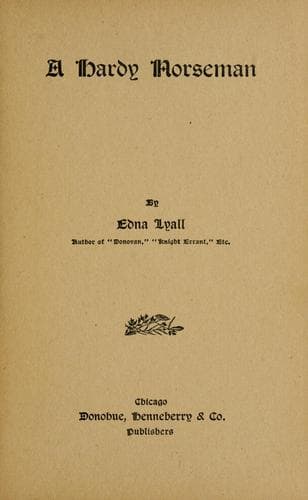
British -- Norway -- Fiction; Conduct of life -- Fiction; Norwegians -- England -- Fiction
All at once the color rushed to her cheeks, for, looking up, she saw
Frithiof crossing the platform; she watched him place the score on the
conductor’s desk, and turn to answer the question of some one in the
orchestra, then disappear again within the swing-doors leading to the
back regions. She wondered much what he was thinking of as he went
through his prosaic duties so rapidly, wondered if his mind was away in
Norway all the time—whether autumn had brought to him, as she knew it
generally did, the strong craving for his old life of adventure—the
longing to handle a gun once more; or whether, perhaps, his trouble had
overshadowed even that, and whether he was thinking instead of that
baffling mystery which had caused them all so much pain. And all through
the oratorio she seemed to be hearing everything with his ears;
wondering how the choruses would strike him, or hoping that he was in a
good place for hearing Albani’s exquisite rendering of “Hear ye,
Israel.” She wondered a little that Roy did not come to her, or, at any
rate, send her some message, and at the end of the last chorus began to
feel a little anxious and uncomfortable. At last, to her great relief,
she saw Frithiof coming toward her.
“Your brother has never come,” he said, in reply to her greeting. “I
suppose this fog must have hindered him, for he told me he should be
here; and I have been expecting him every moment.”
“Is the fog so bad as all that?” said Cecil, rather anxiously.
“It was very bad when I came,” said Frithiof. “However, by good luck, I
managed to grope my way to Portland Road, and came down by the
Metropolitan. Will you let me see you home?”
“Thank you, but it is so dreadfully out of your way. I should be very
glad if you would, only it is troubling you so much.”
Something in her eager yet half-shy welcome, and in the sense that she
was one of the very few who really believed in him, filled Frithiof with
a happiness which he could scarcely have explained to himself.
“You will be giving me a very great pleasure,” he said. “I expect there
will be a rush on the trains. Shall we try for a cab?”
So they walked out together into the dense fog, Cecil with a blissful
sense of confidence in the man who piloted her so adroitly through the
crowd, and seemed so astonishingly cool and indifferent amid the
perilous confusion of wheels and hoofs, which always appeared in the
quarter where one least expected them.
At last, after much difficulty, Frithiof secured a hansom, and put her
into it. She was secretly relieved that he got in too.
“I will come back with you if you will allow me,” he said; “for I am not
quite sure whether this is not a more dangerous part of the adventure
than when we were on foot. I never saw such a fog! Why, we can’t even
see the horse, much less where he is going.”
“How thankful I am that you were here! It would have been dreadful all
alone,” said Cecil; and she explained to him how Mrs. Horner had failed
her at the last moment.
Public-domain text, read in full here on John Shaqi.
Reviews
Reviews
No reviews yet
Be the first to share your thoughts on this work.
Elsewhere in the archive
Join the Discussion
Join the discussion
Sign in to leave a comment or review.
Sign InorCreate an account