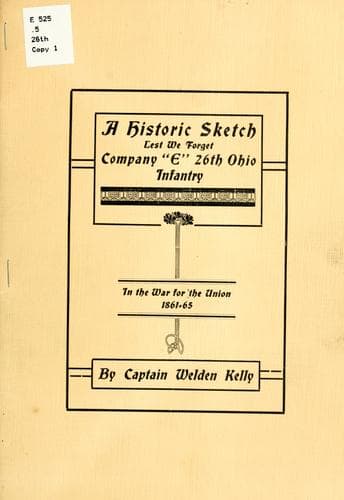
A Historic Sketch, Lest We Forget Company "E," 26th Ohio Infantry in the War for the Union, 1861-65 — John Shaqi
A Historic Sketch, Lest We Forget Company "E," 26th Ohio Infantry in the War for the Union, 1861-65Kelly, Walden
History
A Historic Sketch, Lest We Forget Company "E," 26th Ohio Infantry in the War for the Union, 1861-65
Kelly, Walden
United States -- History -- Civil War, 1861-1865 -- Regimental histories; United States. Army. Ohio Infantry Regiment, 26th (1861-1865)
In the reorganization of the army, the 20th and 21st army corps were
practically consolidated and formed the 4th corps. In this organization we
became part of the 2nd brigade, commanded by General Geo. D. Wagner, 2nd
division commanded by Major General P. H. Sheridan. Our regiment was taken
out of the line of battle and camped in the town and heavy details made
from it to guard the supply trains to Bridgeport, Ala., and return. It was
our understanding at the time that we were to be detached from the brigade
and become a part of the local garrison. We having been the first to
occupy and patrol the place, we felt that it was due us, and having been
so fearfully mangled at Chickamauga it would give time to partially
recuperate, but Sheridan objected, stating that such regiments, full of
experience, could not be spared from the front, and we were soon doing
picket duty. No supplies could be furnished by the country to which we had
access. The road traveled to bring them was a mountainous one and sixty
miles to railroad. The mules were shortly fed and heavily worked. The
rainy season opened and our rations grew less and less until a half ration
was issued to the men. Bacon was not issued, but fresh beef was used in
its place. The cattle were driven from the Ohio river, a distance of near
400 miles, and grazing in the mountainous country was not well calculated
to produce fat. Hence we got the expression, which originated at
Chattanooga during the siege, "beef dried on the hoof." This was the
situation when General Thomas telegraphed Grant: "We can hold the place
till we starve." Over ten thousand horses and mules died during the siege
and those that survived were in no condition for service.
Public-domain text, read in full here on John Shaqi.
Reviews
Reviews
No reviews yet
Be the first to share your thoughts on this work.
Join the Discussion
Join the discussion
Sign in to leave a comment or review.
Sign InorCreate an account