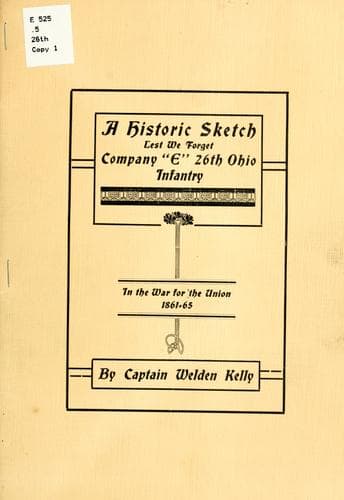
A Historic Sketch, Lest We Forget Company "E," 26th Ohio Infantry in the War for the Union, 1861-65Kelly, Walden
History
A Historic Sketch, Lest We Forget Company "E," 26th Ohio Infantry in the War for the Union, 1861-65
Kelly, Walden
United States -- History -- Civil War, 1861-1865 -- Regimental histories; United States. Army. Ohio Infantry Regiment, 26th (1861-1865)
Mountain, and Fayetteville and were engaged with the enemy at Horseshoe
Bend, Sewal Mountain and New River. The casualty of battle, however, was
one. Corporal John McCausland, by concussion of a bursting shell, was
seriously injured at Horseshoe Bend. Our loss from all causes was three
deaths from disease and ten discharged because of disability. The company
had seven deserters during its entire service, but as none of them were of
value to the company or government, we drop them at this early stage. Some
of them, however, were carried on the roll to a later date. One only of
this number enlisted from Morrow county. The regiment was transferred to
Louisville--
"Way down in old Kentucky,
Where they never have the blues,
Where the Captains shoot the Colonels,
And the Colonels shoot the Booze"--
And marched to Bardstown where the regiment became part of the 15th
brigade, commanded by General Milo Haskel; 6th division, commanded by
General Thos. J. Wood; army of the Ohio, commanded by General Don Carlos
Buell. In this brigade[2] the 26th regiment remained during the entire
war, the other three regiments forming the brigade leaving us at different
periods--the 17th Indiana to Wilders Mounted Infantry, the 58th Indiana
became the pontooniers of the army of the Cumberland, and the 3rd Kentucky
was transferred to General Harker's brigade, remaining in the same
division. In February, 1862, the division moved on Bowling Green, thence
to Nashville, Tenn., and from there was the 4th division in line of
march, under Buell, to Pittsburg Landing, arriving on the field of battle
as the enemy was leaving. Our wagons were left some miles in the rear, on
the opposite side of the Tennessee River, and did not reach us for about
ten days. We carried our rations from the Hamburg Landing to camp--a
distance of nearly four miles. In the slow approach of our army on
Corinth, Miss., we were several times quite heavily engaged, skirmishing
with the enemy, losing a few men from the regiment, but company E suffered
no losses. On the evacuation by the Confederate forces we were moved
eastward along the line of the Memphis & Charleston railroad, crossing to
the north side of the Tennessee River at Decatur, Alabama, about July 6th,
1862, thence through Huntsville northeast into Tennessee via Fayetteville,
Winchester, Deckard and Hillsboro to McMinnville, on August 30th, 1862, by
a very rapid march of eight miles. Terminating by a double quick, we
succeeded in striking Forest's cavalry, driving them so rapidly that we
captured their ambulance, with medical supplies, and also one of the
General's horses. For rapidity of march and promptness in action the
regiment was complimented in general orders by the division commander.
September 2nd we started from McMinnville via Murfreesboro, Nashville,
Bowling Green and Mumfordville, for Louisville, Ky., to intercept Bragg,
who had invaded Kentucky through East Tennessee and was threatening
Cincinnati and Louisville.
Public-domain text, read in full here on John Shaqi.
Reviews
Reviews
No reviews yet
Be the first to share your thoughts on this work.
Join the Discussion
Join the discussion
Sign in to leave a comment or review.
Sign InorCreate an account