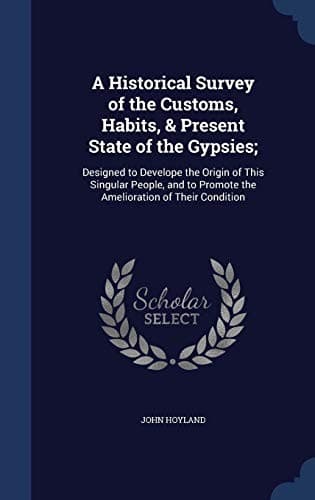
A Historical Survey of the Customs, Habits, & Present State of the GypsiesHoyland, John
History
A Historical Survey of the Customs, Habits, & Present State of the Gypsies
Hoyland, John
Romanies
“And whereas also yt appeareth by dayly experience, that the number of
idle, vagraunte, loyteringe, sturdy roags, masterles men, lewde and yll
disposed persons are exceedingly encreased, and multiplied, committinge
many grevious and outeragious disorders and offences, tendinge to the
great . . . of Allmightie God, the contempte of her Majestie’s laws, and
to the great charge, troble, and disquiet of the common welth.—We the
Justices of Peace, above speciefied, assembled and mett together at our
general sessions above named, for remedie of theis and such lyke
enormities which hereafter shall happen to arise or growe within the
hundreths and lymits aforesaid, doe by theis presents, order, decree and
ordeyne, That there shall be builded or provided one convenient house,
which shall be called the House of Correction; and that the same be
established within the towne of Bury, within the hundreth of Thingoe
aforesaid. And that all persons offendinge or lyvinge contrary to the
tenor of the said twoe Acts, within the hundreths and lymitts aforesaid,
shal be, by the warrante of any Justice of Peace, dwellinge in the same
hundreths or lymitts, committed thether and there be releived, punished,
sett to worke, and ordered in such sorte, and accordinge to the
directions, provisions, and limitations, hereafter in theis presents
declared and specified.
“Fyrst, That yt maie appeare what persons arre to be apprehended,
committed and brought to the House of Correction, it is ordered and
appointed, That all and every person and persons which shal be found and
taken within the hundreths and lymitts aforesaid, above the age of 14
yeares, and shall take upon them to be procters or procurators goinge
aboute withowt sufficiente lycence from the Queen’s Majestie. All idle
persons goinge aboute usinge subtiltie and unlawfull games or plaie—all
such as faynt themselves to have knowledge in phisiognomye, palmestrie or
other abused sciences—all tellers of destinies, deaths or fortunes, and
such lyke fantasticall imaginations.”
From the tenor of the above Ordinance, it might be inferred that, at the
time of issuing it, Gypsies, and their adherents, abounded in the County
of Suffolk; and it may be concluded, that they continued to attach
themselves to that part of the nation, as Judge Hale remarks, that “at
one Suffolk Assize, no less than thirteen Gypsies were executed upon
these Statutes, a few years before the restoration.”
To the honour of our national humanity, however, Judge Blackstone
observes, there are no instances more modern than this, of carrying these
laws into practice; and the last, sanguinary act is itself now repealed.
The severe statute of 5th Eliz. c. 20 is repealed by 23d Geo. III. c.
51—and Gypsies are now only punishable under the Vagrant Act, which
declares, “that all persons pretending to be Gypsies, or wandering in the
habit, and form of Egyptians, shall be deemed rogues, and
vagabonds.”—17th Geo. II. c. 5.
Public-domain text, read in full here on John Shaqi.
Reviews
Reviews
No reviews yet
Be the first to share your thoughts on this work.
Join the Discussion
Join the discussion
Sign in to leave a comment or review.
Sign InorCreate an account