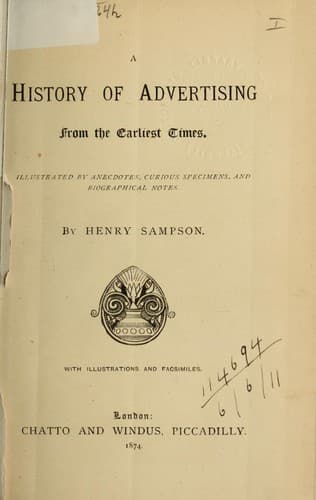
A History of Advertising from the Earliest Times.Sampson, Henry
History
A History of Advertising from the Earliest Times.
Sampson, Henry
Advertising -- History
Mr Jones, culpable as he undoubtedly was, seems to have possessed a
sense of honour, and probably he served his friends as well as himself
by taking the writs from the mail. The reward offered for his
apprehension is so paltry in proportion to the outcry raised, that a
disinterested reader, _i.e._, one who has never felt the smart of
highway robbery, cannot help hoping that he got clear off, or that at
all events he cheated the gallows by earning a soldier’s death “in some
of the new-raised troops.” Although Mr Jones was a gentleman thief, and
had gentlemanly associates, he and his friends are the exceptions to the
rule; for robbers generally are described as a very sad as well as a
very ugly lot of reprobates. Also in the same eventful year of delivery
we find the following, which appears in the _London Gazette_, the
subject of it having evidently thought to avail himself of the
disturbances of the time, but whether successfully or the reverse, does
not appear:--
RUN away from his master, Captain St Lo, the 21st instant, Obdelah
Ealias Abraham, a Moor, swarthy complexion, short frizzled hair, a
gold ring in his ear, in a black coat and blew breeches. He took with
him a blew Turkish watch-gown, a Turkish suit of clothing that he used
to wear about town, and several other things. Whoever brings him to Mr
Lozel’s house in Green Street shall have one guinea for his charges.
This advertisement is suggestive of the taste in blackamoors, which
began to manifest itself about this time, and which had a long run--the
coloured creature who was in later times a negro, but in these a Moor,
being often regarded as a mere soulless toy, a companion of the pug-dog,
or an ornament to be classified with the vases and other china
monstrosities which were just then the vogue. The next advertisement we
have is of a very different character, and has a distinct bearing upon
the political question of the times; it also seems to show that the
value of advertising was beginning to be still more understood, and that
with the advent of a new sovereign the attention of the commercial
classes was once more directed so much to business that even party
feeling was to be made a source of profit. The extract is from the _New
Observator_ of July 17, 1689:--
Public-domain text, read in full here on John Shaqi.
Reviews
Reviews
No reviews yet
Be the first to share your thoughts on this work.
Elsewhere in the archive
Join the Discussion
Join the discussion
Sign in to leave a comment or review.
Sign InorCreate an account