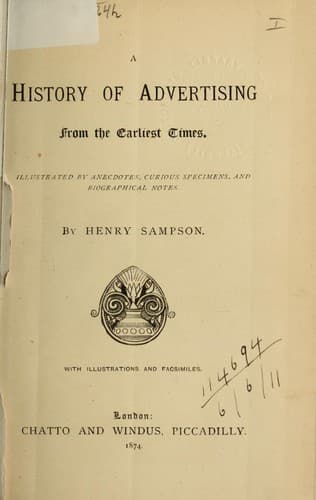
A History of Advertising from the Earliest Times.Sampson, Henry
History
A History of Advertising from the Earliest Times.
Sampson, Henry
Advertising -- History
ORANGE CARDS, representing the late King’s reign and expedition of the
Prince of Orange; viz. The Earl of Essex Murther, Dr Otes Whipping,
Defacing the Monument, My Lord Jeferies in the West hanging of
Protestants, Magdalen College, Trial of the Bishops, Castle Maine at
Rome, The Popish Midwife, A Jesuit Preaching against our Bible,
Consecrated Smock, My Lord Chancellor at the Bed’s feet, Birth of the
Prince of Wales, The Ordinare Mass-house pulling down and burning by
Captain Tom and his Mobile, Mortar pieces in the Tower, The Prince of
Orange Landing, The Jesuits Scampering, Father Peter’s Transactions,
The fight at Reading, The Army going over to the Prince of Orange,
Tyrconnel in Ireland, My Lord Chancellor in the Tower. With many other
remarkable passages of the Times. To which is added the efigies of our
Gracious K. William & Q. Mary, curiously illustrated and engraven in
lively figures, done by the performers of the first Popish Plot Cards.
Sold by Donnan Newman, the publisher and printer of the New
Observator.
This was a popular and rather practical method of celebrating the
triumph of the Whigs, and as Bishop Burnet was the editor of the _New
Observator_, and these cards were sold by his publisher, he is very
likely to have had a hand in their promotion. About now the traffic in
African slaves commenced, and these full-blooded blacks gradually
displaced the Moors and Arabs, who had formerly been the prevalent
coloured “fancy.” It is supposed that the taste for these dark-skinned
servants was derived from the Venetians, whose intercourse with the
traders of India and Africa naturally led to their introduction. Moors
are constantly being associated with the sea-girt Republic, both in
literature and art, Shakespeare’s “Moor of Venice” being somewhat of an
instance in point; while Titian and other painters of his school were
extremely fond of portraying coloured men of all descriptions. By 1693,
however, the negro had not altogether pushed out the Moor, if we may
judge by an advertisement dated January 9-12, 1692-93, and appearing in
the _London Gazette_:--
THOMAS GOOSEBERRY, a blackamoor, aged about 24 years, a thin slender
man, middle stature, wears a periwig: Whoever brings him to Mr John
Martin at Guildhall Coffeehouse, shall have two guineas Reward.
Another advertisement, which appears in the same paper a couple of years
later, shows that the owners of these chattels considered their rights
of property complete, as they put collars round their necks with names
and addresses, just the same as they would have placed on a dog, or
similar to that worn by “Gurth the thrall of Cedric.” This individual
seems to have been different from any of the others we have met, as he
is evidently a dusky Asiatic who has been purchased from his parents by
some adventurous trader, and whose thraldom sits heavily upon him. This
is his description:--
Public-domain text, read in full here on John Shaqi.
Reviews
Reviews
No reviews yet
Be the first to share your thoughts on this work.
Elsewhere in the archive
Join the Discussion
Join the discussion
Sign in to leave a comment or review.
Sign InorCreate an account