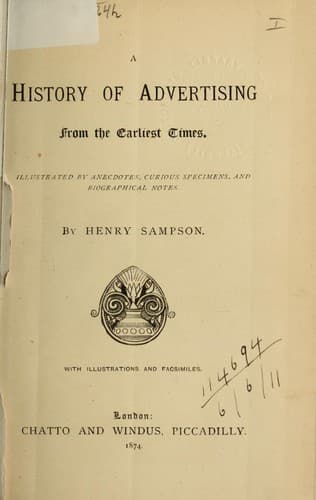
A History of Advertising from the Earliest Times.Sampson, Henry
History
A History of Advertising from the Earliest Times.
Sampson, Henry
Advertising -- History
AT the Angel and Crown in Basing-lane near Bow-lane liveth J. Pechey,
a Graduate in the University of Oxford, and of many years standing in
the College of Physicians in London: where all sick people that come
to him, may have for Six pence a faithful account of their diseases,
and plain directions for diet and other things they can prepare
themselves. And such as have occasion for Medicines may have them of
him at any reasonable rates, without paying anything for advice. And
he will visit any sick person in London or the Liberties thereof in
the day time for two shillings and Six pence, and anywhere else within
the Bills of Mortality for Five shillings. And if he be called in by
any person as he passes by in any of these places, he will require but
one shilling for his advice.
This is cheap enough, in all conscience, and yet there is little doubt
that the afflicted infinitely preferred the nostrums so speciously
advertised by empirics to treatment according to the pharmacopœia. We
have good authority for the statement that faith will move mountains,
and it seems, if we are to judge by the testimonials published from
time immemorial by vendors of ointment and pills, to have moved
mountainous tumours, wens, and carbuncles, for without it soft soap,
bread, and bacon fat would be of little use indeed. Glorious John Dryden
died early in this year, and a hoaxing advertisement appeared in the
_Post Boy_ of May 4-7, which called for elegies, &c.:--
THE Death of the famous John Dryden Esq. Poet Laureat to their two
late Majesties, King Charles and King James the Second; being a
Subject capable of employing the best pens, and several persons of
quality and others, having put a stop to his interment, which is to be
in Chaucer’s grave, in Westminster Abbey: This is to desire the
gentlemen of the two famous universities, and others who have a
respect for the memory of the deceas’d, and are inclinable to such
performances, to send what copies they please as Epigrams, etc. to
Henry Playford at his shop at the Temple-Change in Fleet street, and
they shall be inserted in a Collection which is design’d after the
same nature and in the same method (in what language they shall
please) as is usual in the composures which are printed on solemn
occasions at the two Universities aforesaid.
Other advertisements followed this, and from them it appears that the
shop of Henry Playford was inundated with manuscripts of all lengths and
kinds, and in many languages. What became of them does not make itself
known, which is a pity, as many must have been equal to any specimen
which occurs in the “Rejected Addresses,” with the advantage and
recommendation of being genuine.
Public-domain text, read in full here on John Shaqi.
Reviews
Reviews
No reviews yet
Be the first to share your thoughts on this work.
Elsewhere in the archive
Join the Discussion
Join the discussion
Sign in to leave a comment or review.
Sign InorCreate an account