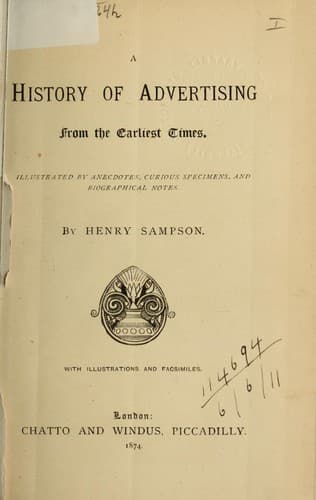
A History of Advertising from the Earliest Times.Sampson, Henry
History
A History of Advertising from the Earliest Times.
Sampson, Henry
Advertising -- History
Bank, and a similar amount by the East India Company. The officials of
the Company were forbidden to leave the kingdom for twelve months, or to
dispose of any of their property or effects. Ultimately various schemes,
involving the deepest fraud and villany, were discovered to have been
secretly concocted and carried out by the directors; and it was proved
that the Earl of Sunderland, the Duchess of Kendal, the Countess Platen
and her two nieces, Mr Craggs, M.P., the Company’s secretary, Mr Charles
Stanhope, a secretary of the Treasury, and the Sword Blade Company, had
been bribed to promote the Company’s bill in Parliament by a present of
£170,000 of South Sea stock. The total amount of fictitious stock
created for this and similar purposes was £1,260,000, nearly one-half of
which had been disposed of. Equally flagrant iniquity in the allocation
of shares was discovered, in which, among others, Mr Aislabie, the
Chancellor of the Exchequer, was implicated. Of these offenders, Mr
Stanhope and the Earl of Sunderland were acquitted through the unworthy
partiality of the Parliament; but Mr Aislabie, and the other directors
who were members of the House of Commons, were expelled; most of the
directors were discovered, and all of them suffered confiscation of
their possessions. The chairman was allowed to retain only £5000 out of
£183,000, and others in proportion to their share in the fraudulent
transactions of the Company. At the end of 1720, it being found that
£13,300,000 of real stock belonged to the Company, £8,000,000 of this
was taken and divided among the losers, giving them a dividend of 33⅓
per cent.; and by other schemes of adjustment the pressure was so fairly
and wisely distributed, that the excitement gradually subsided.” It will
thus be seen that the South Sea Bubble was, after all, not more
disastrous in its effects than many modern and comparatively unknown
speculations.
It is singular that the South Sea Bubble led to little--almost
nothing--in the way of advertisements. When we think of the columns
which now herald the advent of any new company, or for the matter of
that, any new idea of an old company, or any fresh specific or article
of clothing, it seems strange that at a time when the art of advertising
was fast becoming fashionable, no invitations to subscribe were
published in any of the daily or weekly papers that then existed. Just
before the consent of Parliament was obtained we find one or two stray
advertisements certainly, but they have no official status, as may be
judged by this, which is from the _Post Boy_, April 2-5, 1720:--
Public-domain text, read in full here on John Shaqi.
Reviews
Reviews
No reviews yet
Be the first to share your thoughts on this work.
Elsewhere in the archive
Join the Discussion
Join the discussion
Sign in to leave a comment or review.
Sign InorCreate an account