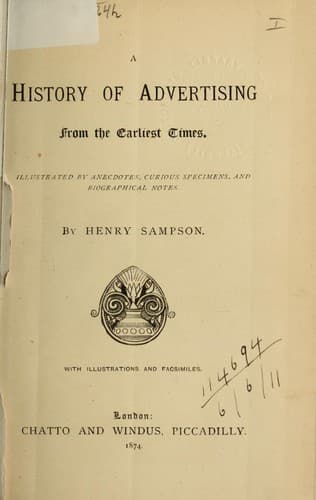
A History of Advertising from the Earliest Times.Sampson, Henry
History
A History of Advertising from the Earliest Times.
Sampson, Henry
Advertising -- History
which would thus accrue to the South Sea Company, submitted to
Government a counter-proposal; but the more dazzling nature of their
rival’s offer secured its acceptance by Parliament--in the Commons by
172 to 55, and (April 7) in the Lords by 83 to 17; Sir Robert Walpole in
the former, and Lords North and Grey, the Duke of Wharton and Earl
Cowper in the latter, in vain protesting against it as involving
inevitable ruin. During the passing of their bill, the Company’s stock
rose steadily to 330 on April 7,[32] falling to 290 on the following
day. Up till this date the scheme had been honestly promoted; but now,
seeing before them the prospect of speedily amassing abundant wealth,
the directors threw aside all scruples, and made use of every effective
means at their command, honest or dishonest, to keep up the factitious
value of the stock. Their zealous endeavours were crowned with success;
the shares were quoted at 550 on May 28, and 890 on June 1. A general
impression having by this time gained ground that the stock had reached
its maximum, so many holders rushed to realise that the price fell to
630 on June 3. As this decline did not suit the personal interests of
the directors, they sent agents to buy up eagerly; and on the evening of
June 3, 750 was the quoted price. This and similar artifices were
employed as required, and had the effect of ultimately raising the
shares to 1000 in the beginning of August, when the chairman of the
Company and some of the principal directors sold out. On this becoming
known, a widespread uneasiness seized the holders of stock; every one
was eager to part with his shares, and on September 12 they fell to 400,
in spite of all the attempts of the directors to bolster up the
Company’s credit. The consternation of those who had been either unable
or unwilling to part with their scrip was now extreme; many capitalists
absconded, either to avoid ruinous bankruptcy, or to secure their
ill-gotten gains, and the Government became seriously alarmed at the
excited state of public feeling. Attempts were made to prevail on the
Bank to come to the rescue by circulating some millions of Company’s
bonds; but as the shares still declined, and the Company’s chief
cashiers, the Sword Blade Company, now stopped payment, the Bank refused
to entertain the proposal. The country was now wound up to a most
alarming pitch of excitement; the punishment of the fraudulent directors
was clamorously demanded, and Parliament was hastily summoned (December
8) to deliberate on the best means of mitigating this great calamity.
Both Houses proved, however, to be in as impetuous a mood as the public;
and in spite of the moderate counsels of Walpole, it was resolved
(December 9) to punish the authors of the national distresses, though
hitherto no fraudulent acts had been proved against them. An examination
of the proceedings of the Company was at once commenced; and on
Walpole’s proposal nine millions of South Sea bonds were taken up by the
Public-domain text, read in full here on John Shaqi.
Reviews
Reviews
No reviews yet
Be the first to share your thoughts on this work.
Elsewhere in the archive
Join the Discussion
Join the discussion
Sign in to leave a comment or review.
Sign InorCreate an account