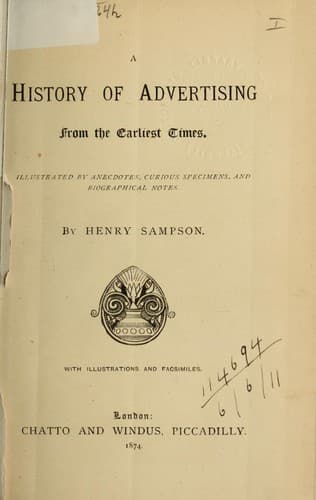
A History of Advertising from the Earliest Times.Sampson, Henry
History
A History of Advertising from the Earliest Times.
Sampson, Henry
Advertising -- History
The further we advance into the years which mark the Hanoverian
succession, the more profligate, reckless, and cruel do the people seem
to become. Public exhibitions of the most disgusting character are every
day advertised; ruffians and swashbucklers abound, and are ready to do
anything for a consideration; animals are tortured at set periods for
the delectation of the multitude; and we see verified, by means of the
notices in the papers, the peculiarities which Hogarth seized and made
immortal, and which so many squeamish people consider to be overdrawn
nowadays. Assignations of the most immoral character are openly
advertised, and men of the time may well have attempted to ignore the
existence of female virtue. A recent writer, commenting on this state of
affairs, says, in reference to the latter class of shameless
advertisements: “We are far from saying that such matters are not
managed now through the medium of advertisements, for they are, but in
how much more carefully concealed a manner? The perfect contempt of
public opinion, or rather the public acquiescence in such infringements
of the moral law which it exhibits, proves the general state of morality
more than the infringements themselves, which obtain more or less at all
times. Two of the causes which led to this low tone of manners with
respect to women were doubtless the detestable profligacy of the courts
of the two first Georges, and the very defective condition of the
existing marriage law. William and Mary, and Anne, had, by their
decorous, not to say frigid lives, redeemed the crown, and in some
measure the aristocracy, from the vices of the Restoration. Crown,
court, and quality, however, fell into a still worse slough on the
accession of the Hanoverian king, who soiled afresh the rising tone of
public life by his scandalous connection with the Duchess of Kendal and
the Countess of Darlington; whilst his son and successor was absolutely
abetted in his vicious courses by his own queen, who promoted his
commerce with his two mistresses, the Countesses of Suffolk and
Yarmouth. The degrading influence of the royal manners was well seconded
by the condition of the law. Keith’s Chapel in Mayfair, and that at the
Fleet, were the Gretna Greens of the age, where children could get
married at any time of the day or night for a couple of crowns. It was
said at the time that at the former chapel six thousand persons were
annually married in this offhand way; the youngest of the beautiful Miss
Gunnings was wedded to the Duke of Hamilton at twelve o’clock at night,
with a ring off the bed-curtain, at this very ‘marriage-shop.’ The
fruits of such unions may be imagined. The easy way in which the
marriage bond was worn and broken through, is clearly indicated by the
advertisements which absolutely crowd the public journals, from the
accession of the house of Brunswick up to the time of the third George,
of husbands warning the public not to trust their runaway wives.” It
Public-domain text, read in full here on John Shaqi.
Reviews
Reviews
No reviews yet
Be the first to share your thoughts on this work.
Elsewhere in the archive
Join the Discussion
Join the discussion
Sign in to leave a comment or review.
Sign InorCreate an account