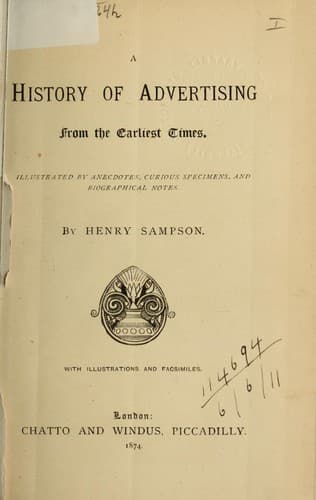
A History of Advertising from the Earliest Times.Sampson, Henry
History
A History of Advertising from the Earliest Times.
Sampson, Henry
Advertising -- History
must not be imagined, though, that wives were the only sinners, or that
vice was confined to any particular and exclusive class. It was the
luxury of all, and according to their opportunities all enjoyed it.
About this time Fleet marriages, and the scandals consequent upon them,
were in full swing. In a number of the _Weekly Journal_ this statement
is made: “From an inspection into the several registers for marriages
kept at the several alehouses, brandy-shops, &c., within the Rules of
the Fleet Prison, we find no less than thirty-two couples joined
together from Monday to Thursday last without licences, contrary to an
express Act of Parliament against clandestine marriages, that lays a
severe fine of £200 on the minister so offending, and £100 each on the
persons so married in contradiction to the said statute. Several of the
above-named brandy-men and victuallers keep clergymen in their houses at
20s. per week, hit or miss; but it is reported that one there will stoop
to no such low conditions, but makes at least £500 per annum of Divinity
jobs after that manner.” A fair specimen of the kind of advertisement
published by these gentlemen is this:--
G. R.--At the True Chapel, at the old Red Hand and Mitre, three doors
up Fleet Lane, and next door to the White Swan, Marriages are
performed by authority by the Rev. Mr. Symson, educated at the
University of Cambridge, and late chaplain to the Earl of Rothes.
_N.B._--Without imposition.
A curious phase of the dangers of the streets is found in a narrative
published in the _Grub Street Journal_ of 1735, which is well worth
reproducing: “Since midsummer last a young lady of birth and fortune was
deluded and forced from her friends, and by the assistance of a
wrynecked swearing parson, married to an atheistical wretch, whose life
is a continued practice of all manner of vice and debauchery. And since
the ruin of my relative, another lady of my acquaintance had like to
have been trepanned in the following manner: This lady had appointed to
meet a gentlewoman at the Old Playhouse in Drury Lane, but extraordinary
business prevented her coming. Being alone when the play was done, she
bade a boy call a coach for the city. One dressed like a gentleman helps
her into it, and jumps in after her. ‘Madam,’ says he, ‘this coach was
called for me, and since the weather is so bad, and there is no other, I
beg leave to bear you company; I am going into the City, and will set
you down wherever you please.’ The lady begged to be excused, but he
bade the coachman drive on. Being come to Ludgate Hill, he told her his
sister, who waited his coming but five doors up the court, would go with
her in two minutes. He went, and returned with his pretended sister, who
asked her to step in one minute, and she would wait upon her in the
coach. The poor lady foolishly followed her into the house, when
instantly the sister vanished, and a tawny fellow in a black coat and a
black wig appeared.
Public-domain text, read in full here on John Shaqi.
Reviews
Reviews
No reviews yet
Be the first to share your thoughts on this work.
Elsewhere in the archive
Join the Discussion
Join the discussion
Sign in to leave a comment or review.
Sign InorCreate an account