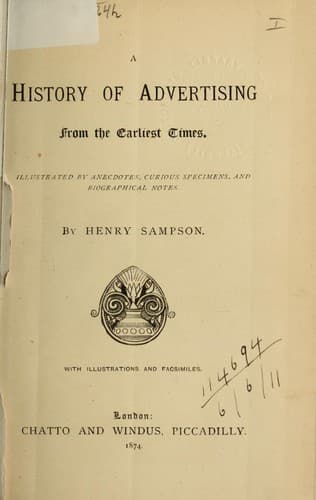
A History of Advertising from the Earliest Times.Sampson, Henry
History
A History of Advertising from the Earliest Times.
Sampson, Henry
Advertising -- History
‘Madam, you are come in good time, the doctor was
just agoing!’ ‘The doctor!’ says she, terribly frighted, fearing it was
a madhouse; ‘what has the doctor to do with me?’ ‘To marry you to that
gentleman. The doctor has waited for you these three hours, and will be
paid by you or that gentleman before you go!’ ‘That gentleman,’ says
she, recovering herself, ‘is worthy a better fortune than mine;’ and
begged hard to be gone. But Doctor Wryneck swore she should be married;
or if she would not he would still have his fee, and register the
marriage for that night. The lady finding she could not escape without
money or a pledge, told them she liked the gentleman so well she would
certainly meet him to-morrow night, and gave them a ring as a pledge,
‘which,’ says she, ‘was my mother’s gift on her deathbed, enjoining
that, if ever I married, it should be my wedding ring;’ by which cunning
contrivance she was delivered from the black doctor and his tawny crew.”
Pennant, in his “Some Account of London,” says: “In walking along the
street in my youth, on the side next the prison, I have often been
tempted by the question, ‘Sir, will you be pleased to walk in and be
married?’ Along this most lawless space was hung up the frequent sign of
a male and female hand enjoined, with ‘Marriages performed within’
written beneath. A dirty fellow invited you in. The parson was seen
walking before his shop; a squalid, profligate figure, clad in a
tattered plaid nightgown, with a fiery face, and ready to couple you for
a dram of gin or a roll of tobacco.” Some of the notes found in the
registers purchased by Government in 1821, and deposited with the
Registrar of the Consistory Court of London, are very amusing. Here are
one or two extracts: “June 10, 1729. John Nelson, of ye parish of St
George, Hanover, batchelor and gardener, and Mary Barnes, of ye same,
sp. married. Cer. dated 5 November 1727, to please their parents.”
“1742, May 24.--A soldier brought a barber to the Cock, who I think said
his name was James, barber by trade, was in part married to Elizabeth:
they said they were married enough.” “A coachman came, and was half
married, and would give but 3s. 6d., and went off.” “Edward ---- and
Elizabeth ---- were married, and would not let me know their names.” A
popular error was current at this time, that if a newly-married woman
ran across the street with nothing on but her shift, she would free her
husband from all liability as to her debts. More than once the
following, or words akin to it, is found: “The woman ran across Ludgate
Hill in her shift.” Riotous persons often terrified these parsons, such
memoranda as the following occurring now and again: “Had a noise for
four hours about the money.” “Married at a barber’s shop one Kerrils,
for half a guinea, after which it was extorted out of my pocket, and for
fear of my life delivered.” “Harrowson swore most bitterly, and was
pleased to say that he was fully determined to kill the minister that
married him.
Public-domain text, read in full here on John Shaqi.
Reviews
Reviews
No reviews yet
Be the first to share your thoughts on this work.
Elsewhere in the archive
Join the Discussion
Join the discussion
Sign in to leave a comment or review.
Sign InorCreate an account