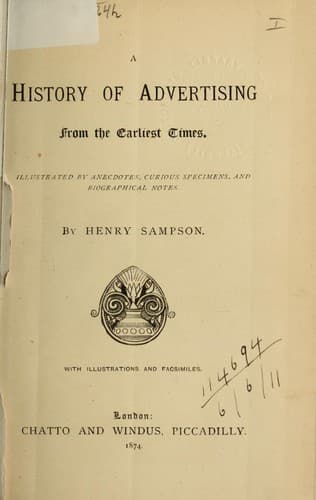
A History of Advertising from the Earliest Times.Sampson, Henry
History
A History of Advertising from the Earliest Times.
Sampson, Henry
Advertising -- History
We have already referred to an article written by Dr Johnson, in an
_Idler_ of 1759, on the subject of advertisements. It is very amusing,
and in it he says that “whatever is common is despised. Advertisements
are now so numerous that they are very negligently perused, and it is
therefore become necessary to gain attention by magnificence of
promises, and by eloquence sometimes sublime and sometimes pathetic.” He
then passes in review some of the most inflated puffs of that period,
and continues: “Promise, large promise, is the soul of an advertisement.
I remember a washball that had a quality truly wonderful--it gave an
exquisite edge to the razor. And there are now to be sold, for ready
money only, some duvets for bed-coverings, of down, beyond comparison
superior to what is called ottar down, and indeed such, that its many
excellences cannot be here set forth. With one excellence we are made
acquainted--it is warmer than four or five blankets, and lighter than
one. There are some, however, that know the prejudice of mankind in
favour of modest sincerity. The vendor of the beautifying fluid sells a
lotion that repels pimples, washes away freckles, smooths the skin, and
plumps the flesh; and yet, with a generous abhorrence of ostentation,
confesses that it will not restore the bloom of fifteen to a lady of
fifty. The true pathos of advertisements must have sunk deep into the
heart of every man that remembers the zeal shown by the seller of the
anodyne necklace, for the ease and safety of poor toothing infants, and
the affection with which he warned every mother, that she would never
forgive herself if her infant should perish without a necklace. I cannot
but remark to the celebrated author, who gave, in his notifications of
the camel and dromedary, so many specimens of the genuine sublime, that
there is now arrived another subject yet more worthy of his pen--A
famous Mohawk Indian warrior, who took Dieskaw, the French general,
prisoner, dressed in the same manner with the native Indians when they
go to war, with his face and body painted, with his scalping knife,
tom-axe, and all other implements of war! A sight worthy the curiosity
of every true Briton! This is a very powerful description: but a critic
of great refinement would say that it conveys rather horror than terror.
An Indian, dressed as he goes to war, may bring company together; but if
he carries the scalping knife and tom-axe, there are many true Britons
that will never be persuaded to see him but through a grate. It has been
remarked by the severer judges, that the salutary sorrow of tragic
scenes is too soon effaced by the merriment of the epilogue: the same
inconvenience arises from the improper disposition of advertisements.
The noblest objects may be so associated as to be made ridiculous. The
camel and dromedary themselves might have lost much of their dignity
between the true flower of mustard and the original Daffy’s Elixir; and
Public-domain text, read in full here on John Shaqi.
Reviews
Reviews
No reviews yet
Be the first to share your thoughts on this work.
Elsewhere in the archive
Join the Discussion
Join the discussion
Sign in to leave a comment or review.
Sign InorCreate an account