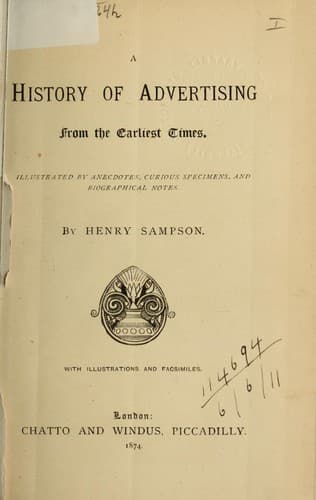
A History of Advertising from the Earliest Times.Sampson, Henry
History
A History of Advertising from the Earliest Times.
Sampson, Henry
Advertising -- History
In 1785 was established the _Daily Universal Register_, a paper which
was, under a new title, adopted in 1788, to develop into the greatest
and most powerful organ in the world. On the 1st of January, in the
last-named year, the _Register_ appeared with the following heading:
_The Times, or Daily Universal Register, printed Logographically_. The
price was threepence, and for many years the _Times_ gave no promise of
future greatness; but it was always fearless, and very early was fined,
while its editor narrowly escaped imprisonment. In 1790 Mr Walter was
actually incarcerated in Newgate, where he remained sixteen months,
besides being fined £200, for a libel on the Dukes of York and Clarence.
He was released eventually at the intercession of the Prince of Wales.
The history of the _Times_ has been told so often that particulars are
hardly needed here; but as showing how its present eminence is due to
nothing but perseverance and integrity, as well as the everpresent
desire to be first wherever possible, we quote the following from a
short notice of the life of one of its proprietors: “It was under John
Walter II., born in 1784, that the _Times_ rose to the place of the
first newspaper in the world. Whilst yet a youth, in 1803 he became
joint proprietor and sole manager of the _Times_, and very soon his hand
became manifest in the vigour and independence of its politics, and the
freshness of its news. Free speech, however, had its penalties. The
_Times_ denounced the malpractices of Lord Melville, and the Government
revenged itself by withdrawing from the Walters the office of printers
to the Customs, which had been held by the family for eighteen years.
During the war between Napoleon and Austria in 1805, the desire for news
was intense. To thwart the _Times_ the packets for Walter were stopped
at the outports, while those for the ministerial journals were hurried
to London. Complaint was made, and the reply was given that the editor
might receive his foreign papers as a _favour_; meaning thereby that if
the Government was gracious to the _Times_, the _Times_ should be
gracious to the Government; but Walter would accept no favour on such
terms. Thrown on his own resources, he contrived, by means of superior
activity and stratagem, to surpass the ministry in early intelligence of
events. The capitulation of Flushing in August 1809, was announced by
the _Times_ two days before the news had arrived through any other
channel. In the editorship of the paper he spared neither pains nor
expense. The best writers were employed, and wherever a correspondent or
a reporter displayed marked ability, he was carefully looked after and
his faculty utilised. Correspondents were posted in every great city in
the world, and well-qualified reporters were despatched to every scene
of public interest. The debates in Parliament, law proceedings, public
meetings, and commercial affairs, were all reported with a fulness and
accuracy which filled readers with wonder.
Public-domain text, read in full here on John Shaqi.
Reviews
Reviews
No reviews yet
Be the first to share your thoughts on this work.
Elsewhere in the archive
Join the Discussion
Join the discussion
Sign in to leave a comment or review.
Sign InorCreate an account