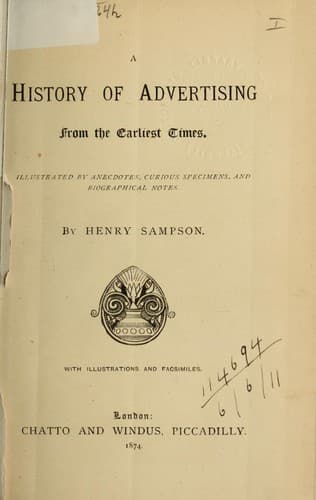
A History of Advertising from the Earliest Times.Sampson, Henry
History
A History of Advertising from the Earliest Times.
Sampson, Henry
Advertising -- History
Some curious and amusing statistics of advertising in the second year of
this century are given by Mr Daniel Stuart, at one time co-proprietor of
the _Morning Post_ with Coleridge, when it was in the meridian of its
fame. He says: “The _Morning Herald_ and the _Times_, then leading
papers, were neglected, and the _Morning Post_, by vigilance and
activity, rose rapidly. Advertisements flowed in beyond bounds. I
encouraged the small miscellaneous advertisements in the front page,
preferring them to any others, upon the rule that the more numerous the
customers, the more independent and permanent the custom. Besides
numerous and various advertisements, I interest numerous and various
readers looking out for employment, servants, sales, and purchasers,
etc. etc. Advertisements act and react. They attract readers, promote
circulation, and circulation attracts advertisements. The _Daily
Advertiser_, which sold to the public for twopence halfpenny, after
paying a stamp-duty of three-halfpence, never had more than half a
column of news; it never noticed Parliament, but it had the best foreign
intelligence before the French Revolution. The _Daily Advertiser_ lost
by its publication, but it gained largely by its advertisements, with
which it was crammed full. Shares in it sold by auction at twenty years’
purchase. I recollect my brother Peter saying, that on proposing to a
tradesman to take shares in a new paper, he was answered with a sneer
and a shake of the head--‘Ah! none of you can touch the _Daily_!’ It was
the paper of business, filled with miscellaneous advertisements,
conducted at little expense, very profitable, and taken in by all
public-houses, coffee-houses, etc., but by scarcely any private
families. It fell in a day by the scheme of Grant, a printer, which made
all publicans proprietors of a rival, the _Morning Advertiser_, the
profits going to a publicans’ benefit society; and they, of course, took
in their own paper;--an example of the danger of depending on any class.
Soon after I joined the _Morning Post_, in the autumn of 1795, Christie,
the auctioneer, left it, on account of its low sale, and left a blank, a
ruinous proclamation of decline. But in 1802 he came to me again,
praying for readmission. At that time particular newspapers were known
to possess particular classes of advertisements: the _Morning Post_,
horses and carriages; the _Public Ledger_, shipping and sales of
wholesale foreign merchandise; the _Morning Herald_ and _Times_,
auctioneers; the _Morning Chronicle_, books. All papers had all sorts of
advertisements, it is true, but some were more remarkable than others
for a particular class, and Mr Perry, who aimed at making the _Morning
Chronicle_ a very literary paper, took pains to produce a striking
display of book advertisements. This display had something more solid
for its object than vanity. Sixty or seventy short advertisements,
filling three columns, by Longman, one day, by Cadell, etc.,
Public-domain text, read in full here on John Shaqi.
Reviews
Reviews
No reviews yet
Be the first to share your thoughts on this work.
Elsewhere in the archive
Join the Discussion
Join the discussion
Sign in to leave a comment or review.
Sign InorCreate an account