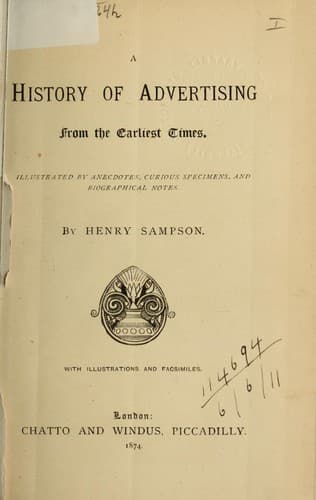
A History of Advertising from the Earliest Times.Sampson, Henry
History
A History of Advertising from the Earliest Times.
Sampson, Henry
Advertising -- History
names, size, horse-power, times of starting, and fares, of numberless
steamers which ply within the limits of British seas. Whether, in short,
he wishes to be conveyed five miles--from London to Greenwich--or three
thousand--from Liverpool to New York--information equally conclusive is
afforded him. The head of the second, or sometimes the third column, is
interesting to a more extensive range of readers--namely, to the
curious; for it is generally devoted to what may be called the romance
of advertising. The advertisements which appear in that place are
mysterious as melodramas, and puzzling as rebuses.” These incentives to
curiosity will receive attention a little further on; meanwhile we will
turn to those which are purely curious or eccentric.
The record of these notices to the public is so extensive, and its
ramifications so multifarious, that so far as those advertisements which
simply contain blunders are concerned, we must be satisfied with a
simple summary, and in many cases leave our readers to make their own
comments. Here is a batch of those whose comicality is mainly dependent
upon sins against the rules of English composition. We will commence
with the reward offered for “a keyless lady’s gold watch,” which is,
though, but a faint echo of the “green lady’s parasol” and the “brown
silk gentleman’s umbrella” anecdotes; but the former we give as actually
having appeared, while so far the two latter require verification. A
lady advertises her desire to obtain a husband with “a Roman nose having
strong religious tendencies.” A nose with heavenly tendencies we can
imagine, but even then it would not be Roman. “A spinster particularly
fond of children,” informs the public that she “wishes for two or three
having none of her own.” Then a dissenter from grammar as well as from
the Church Established wants “a young man to look after a horse of the
Methodist persuasion;” a draper desires to meet with an assistant who
would “take an active and energetic interest in a small first-class
trade, and in a quiet family;” and a chemist requests that “the
gentleman who left his stomach for analysis, will please call and get
it, together with the result.” Theatrical papers actually teem with
advertisements which, either from technology or an ignorance of literary
law, are extremely funny, and sometimes alarming, and even the editorial
minds seem at times to catch the infection. One of these journals, in a
puff preliminary of a benefit, after announcing the names of the
performers and a list of the performances, went on: “Of course every one
will be there, and for the edification of those who are absent, a full
report will be found in our next paper.” This is worthy of a place in
any collection: “One pound reward--Lost, a cameo brooch, representing
Venus and Adonis on the Drumcondra-road, about ten o’clock, on Tuesday
evening.” And so is this: “The advertiser, having made an advantageous
Public-domain text, read in full here on John Shaqi.
Reviews
Reviews
No reviews yet
Be the first to share your thoughts on this work.
Elsewhere in the archive
Join the Discussion
Join the discussion
Sign in to leave a comment or review.
Sign InorCreate an account