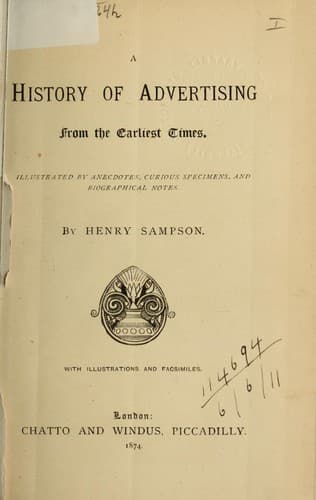
A History of Advertising from the Earliest Times.Sampson, Henry
History
A History of Advertising from the Earliest Times.
Sampson, Henry
Advertising -- History
The publication of births, marriages, and deaths seems to have begun
almost as soon as newspapers were in full swing. At first only the names
of the noble and eminent were given, but soon the notices got into much
the same form as we now find them. One advantage of the old style was
that the amount a man died worth was generally given, though how the
exact sum was known directly he died passes our comprehension, unless it
was then the fashion to give off the secret with the latest breath. Even
under such circumstances we should hesitate to believe some people of
our acquaintance, who have tried now and again, but have never yet
succeeded in telling the truth about their own affairs or those of their
relatives. And doubtless many an heir felt sadly disappointed, on taking
his property, to find it amount to less than half of the published sum.
Notices of marriages and deaths were frequent before the announcement of
births became fashionable; and in advertisements the real order of
things has been completely changed, as obituaries began, marriages
followed, and births came last of all. In the first number of the
_Gentleman’s Magazine_, January 1731, we find deaths and marriages
published under separate heads, and many papers of the time did
likewise. The _Grub Street Journal_ gave them among the summary of
Domestic News, each particular item having the initials of the paper
from which it was taken appended, as was done with all other information
under the same head; for which purpose there was at the top of the
article the information that C. meant _Daily Courant_, P. _Daily
Post-Boy_, D. P. _Daily Post_, D. J. _Daily Journal_, D. A. _Daily
Advertiser_, S. J. _St James’s Evening Post_, W. E. _Whitehall Evening
Post_, and L. E. _London Evening Post_. In the number for February 7,
1734, we find this:--
_Died_ last night at his habitation in Pall-mall, in a very advanced
age, count Kilmanseck, who came over from Hanover with King George I.
_S. J._--At his lodgings. _L. E._ _D. A. Feb. 1._--Aged about 70. _P.
Feb. 1._----Of the small-pox, after 8 days illness, in his 23d year
count Kilmansegg, son of the countess of Kilmansegg, who came over
from Hanover the beginning of the last reign. _D. P. Feb. 1._--He came
over with his highness the prince of Orange, as one of his gentlemen.
_D. J. Feb. 1._--_Tho’_ Mr Conundrum _cannot_ account _for these
different_ accounts _of these two_ German counts, _yet he_ counts _it
certain, that the younger_ count _was the_ son of the countess, who
came over _from the_ county _of_ Hanover.
About the same time we find in the same paper another paragraph worthy
of notice:--
Public-domain text, read in full here on John Shaqi.
Reviews
Reviews
No reviews yet
Be the first to share your thoughts on this work.
Elsewhere in the archive
Join the Discussion
Join the discussion
Sign in to leave a comment or review.
Sign InorCreate an account