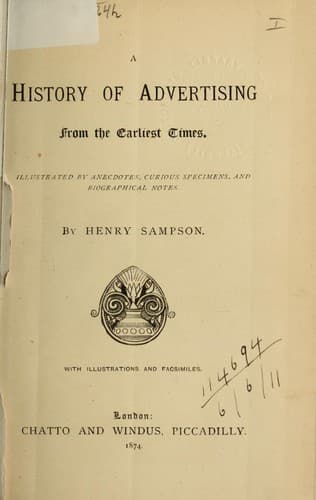
A History of Advertising from the Earliest Times.Sampson, Henry
History
A History of Advertising from the Earliest Times.
Sampson, Henry
Advertising -- History
But turning back to the early times on which we started in quest of
amusing advertisements, we come upon a fictitious letter addressed to
Sylvanus Urban in the _Gentleman’s Magazine_ for September 1803, which
is signed Maria Elderly, and falls sadly foul of the indecorous
announcements then so plentiful. It runs thus: “Good Mr Urban,--You must
know, Sir, I am a married woman and a mother (I bless Heaven!) of
several not unpromising daughters. We read most of the best English and
French authors together as we sit at our work: that is to say one reads
aloud whilst the rest draw, sew, or embroider. The hours thus pass more
pleasantly; and our amusement I will hope is productive of solid mental
profit. It is a proverbial good-natured joke with young gentlemen that
curiosity is of the feminine gender. I will not stop to dispute the
matter with such acute grammarians; but will rather honestly admit that
(although I think otherwise) perhaps ‘much may be said on both sides.’
Nay, I will own, Sir, that what with the natural timidity of my sex, and
the fear of Bonaparte’s invasion, I do feel a little hankering or so, to
learn how the world of politics is conducted. I therefore have lately
taken in a certain fashionable morning newspaper, and was much amused at
first with its contents. But, my dear Mr Urban, I fancy I must give up
this paper; and as I find you are a married gentleman, I will at once
tell you why: I have often been vexed, Sir, at the sight of certain
indecorous advertisements. Proof is better than accusation at all times.
I will therefore just allude to a few, which, however, I assure you, are
not the worst. I know you cannot expect _me_ to transcribe them. The
first instance I shall notice, is in the paper of April 21, 1803, where
‘a lady near 30, wishes to be companion to a single gentleman;’ and as a
proof of the impropriety of this advertisement, Mr O. of Dover Street
(to whom the _lady_ referred) thought it necessary pointedly to deny all
knowledge of her in another advertisement of April 28. In the paper of
May 5, I read that ‘a widow-lady _pleasing in her person_, &c., solicits
the loan of £40 from a gentleman.’ The lady refers to a house in Dean
Street, Soho. In that of May 26 ‘a young female intreats the loan of
£130 from a nobleman or gentleman of fortune.’ She refers to Curriers’
Row, Black friars. In that of June 1, a young lady (who refers to the
post-office, Blandford Street, Portman Square) inserts a most
unqualified proposal indeed. In that of June 16, the proposal is
repeated in still more impertinent terms. The lady now refers to Eyre
Street, Hatton Garden. In that of June 18, appear two advertisements
from females, _of a very curious nature_, addressed to two young men.
Both are assignations; and they are expressed too in very intelligible
terms, I do assure you. I believe you will agree with me that such
advertisements can do no good and may do much harm. I could enlarge my
Public-domain text, read in full here on John Shaqi.
Reviews
Reviews
No reviews yet
Be the first to share your thoughts on this work.
Elsewhere in the archive
Join the Discussion
Join the discussion
Sign in to leave a comment or review.
Sign InorCreate an account