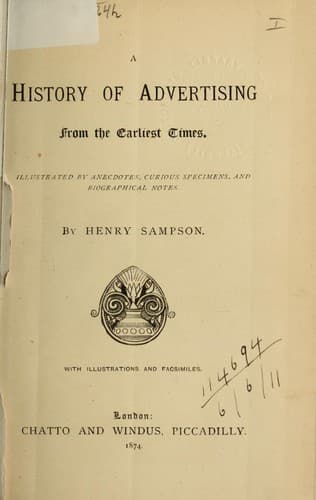
A History of Advertising from the Earliest Times.Sampson, Henry
History
A History of Advertising from the Earliest Times.
Sampson, Henry
Advertising -- History
This looks like an attempt to set the cryptographists on a wrong scent,
and probably means nothing. If it really is a genuine communication, its
scope must be extremely limited. Many of the mysterious advertisements
which appear in the usual style are very noticeable, though of late the
art has fallen a prey to the vendors of quack medicines and cheap books,
and the managers of some theatres and music-halls. What has been
characterised, and with every probability of truth, as the most ghastly
advertisement that ever appeared in a public journal is the following,
which is taken from the _Times_ of the year 1845. It certainly is a most
frightful paragraph:--
TO THE PARTY WHO POSTS HIS LETTERS IN PRINCE’S STREET, LEICESTER
SQUARE.--Your family is now in a state of excitement unbearable. Your
attention is called to an advertisement in Wednesday’s Morning
Advertiser, headed “A body found drowned at Deptford.” After your
avowal to your friend as to what you might do, he has been to see the
decomposed remains, accompanied by others. The features are gone; but
there are marks on the arm; so that unless they hear from you to-day,
it will satisfy them that the remains are those of their misguided
relative, and steps will be directly taken to place them in the family
vault, as they cannot bear the idea of a pauper’s funeral.
The most horrible subject has, however, a ludicrous side, and the idea
of the decomposed remains objecting to parochial interference is as
dreadfully funny as the matter generally is dreadfully shocking. In
another notice, five years later, there is, as it were, a plaintive
moan, the cry of a weak and distressed woman, who has no “strong mind”
to enable her to bear up against infidelity and loss. Listen to it:--
THE one-winged Dove must die unless the Crane returns to be a shield
against her enemies.
Far different is the next, which is a couple of years later, and which
displays as much strength of purpose and self-dependence as its
forerunner betrays weakness:--
IT is enough; one man alone upon earth have I found noble. Away from
me for ever! Cold heart and mean spirit, you have lost what
millions--empires--could not have bought, but which a single word
truthfully and nobly spoken might have made your own to all eternity.
Yet are you forgiven: depart in peace: I rest in my Redeemer.
The reader can imagine the flashing eyes and indignant face of a proud
and wronged woman, as this is read; and it might well be taken as the
text for a whole volume of a modern novel. The next which we select is
still from the _Times_, and appeared several days in succession in
February 1853. It forms a good companion to that which precedes it:
Public-domain text, read in full here on John Shaqi.
Reviews
Reviews
No reviews yet
Be the first to share your thoughts on this work.
Elsewhere in the archive
Join the Discussion
Join the discussion
Sign in to leave a comment or review.
Sign InorCreate an account