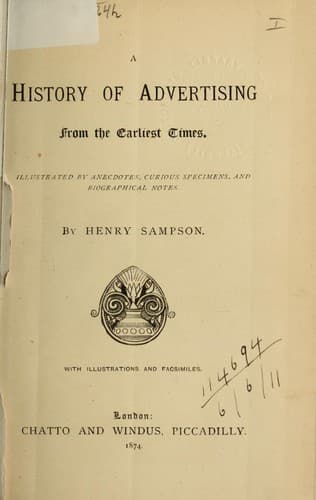
A History of Advertising from the Earliest Times.Sampson, Henry
History
A History of Advertising from the Earliest Times.
Sampson, Henry
Advertising -- History
It has been quite the fashion to say how wrong it was of the lady with
the sick boys to get into a train and spread infection; and nobody seems
to have thought that the poor lads wanted change of air--had perhaps
been ordered it. As no special provision is made for the travelling
sick--or for the matter of that, for the travelling healthy--the fault,
if fault there be, lies not with the mother, who was anxious for the
recovery of her children, but with the railway authorities. Judging from
the tone of the advertisement, we should think that the advertiser would
have resented any interference had his or her young ladies been
travelling as invalids, instead of being in that state of health which
is most subject to the attacks of disease. The case is hard, argued from
either side, but it seems very unfair to cast the blame all one way.
The last example we shall give of this kind of advertising shows that
extended space is used for “personals,” without any extension of
interest, the following being but a mild kind of raving on the part of a
weak-minded man after an obstinate woman. It appeared early during the
present year (1874) in the _Telegraph_:--
MARY ANN C.--Do return home. You labour under an illusion. What you
wish to accuse me with does not exist. This I solemnly declare. I have
at last a good position, but am so wretched that I cannot attend to my
duties properly. Many happier returns of the 1st. God’s blessing be
with thee, and that He may tend thy heart to believe me in truth. Put
six years of love and happiness against your accusation, and you must
feel that you are wrong. Oh, you are very, very wrong. Do write and
give me an appointment, so that happiness may be re-established. You
must be very unhappy, but for God’s sake do not be so strong-minded.
My love and devotion are unaltered. For your own peace, my sweet,
pretty, good wife, come back. When death parts it is sad enough, but
to part while living, and without true cause, creates and leaves
wretchedness to both. Come back to your unhappy but true-loving
husband.
These last extracts are quite sufficient to show the style which now
obtains in this class of advertisements, and to prove that what a score
of years ago promised to be a never-ending source of amusement has
become sadly deficient of its original properties.
Familiar to many people, among curious announcements, will be the
following, which is one of many similar that have from time to time
appeared in the leading journal:--
THE CHANCELLOR of the EXCHEQUER acknowledges the receipt of the first
halves of two £10 notes, conscience-money, for unpaid Income-Tax.
Public-domain text, read in full here on John Shaqi.
Reviews
Reviews
No reviews yet
Be the first to share your thoughts on this work.
Elsewhere in the archive
Join the Discussion
Join the discussion
Sign in to leave a comment or review.
Sign InorCreate an account