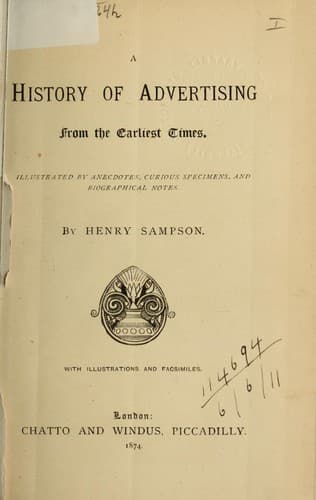
A History of Advertising from the Earliest Times.Sampson, Henry
History
A History of Advertising from the Earliest Times.
Sampson, Henry
Advertising -- History
The public crier, then, was the chief organ by which the mediæval
shopkeeper, in the absence of what we now know as “advertising mediums,”
obtained publicity: it was also customary for most traders to have
touters at their doors, who did duty as living advertisements. In low
neighbourhoods this system still obtains, especially in connection with
cheap photographic establishments, whose “doorsmen” select as a rule the
most improbable people for their attentions, but compensate for this by
their pertinacity and glibness. Possibly the triumph is the greater when
the customer has been persuaded quite out of his or her original
intentions. Most trades, in early times, were almost exclusively
confined to certain streets, and as all the shops were alike
unpretending, and open to the gaze--in fact, were stalls or booths--it
behoved the shopkeeper to do something in order to attract customers.
This he effected sometimes by means of a glaring sign, sometimes by
means of a man or youth standing at the door, and vociferating with the
full power of his lungs, “What d’ye lack, sir? what d’ye lack?” Our
country is rather deficient in that kind of mediæval literature known in
France as _dicts_ and _fabliaux_, which teem with allusions to this
custom of touting, which is noticeable, though, in Lydgate’s ballad of
“London Lyckpenny” (Lack-penny), written in the first half of the
fifteenth century. There we see the shopmen standing at the door, trying
to outbawl each other to gain the custom of the passers-by. The spicer
or grocer bids the Kentish countryman to come and buy some spice,
pepper, or saffron. In Cheapside, the mercers bewilder him with their
velvet, silk, and lawn, and lay violent hands on him, in order to show
him their “Paris thread, the finest in the land.” Throughout all Canwick
(now Cannon Street), he is persecuted by drapers, who offer him cloth;
and in other parts, particularly in East Cheap, the keepers of the
eating-houses sorely tempt him with their cries of “Hot sheep’s feet,
fresh maqurel, pies, and ribs of beef.” At last he falls a prey to the
tempting invitation of a taverner, who makes up to him from his door
with a cringing bow, and taking him by the sleeve, pronounces the words,
“Sir, will you try our wine?” with such an insinuating and irresistible
accent, that the Kentish man enters and spends his only penny in that
tempting and hospitable house. Worthy old Stow supposes this interesting
incident to have happened at the Pope’s Head, in Cornhill, and bids us
enjoy the knowledge of the fact, that for his one penny the countryman
had a pint of wine, and “for bread nothing did he pay, for that was
allowed free” in those good old days. Free luncheons, though rare now,
were commonly bestowed in the seventeenth and eighteenth centuries on
regular drinkers; and the practice of giving food to those who pay for
drink is still current in many parts of the United States. The
Public-domain text, read in full here on John Shaqi.
Reviews
Reviews
No reviews yet
Be the first to share your thoughts on this work.
Elsewhere in the archive
Join the Discussion
Join the discussion
Sign in to leave a comment or review.
Sign InorCreate an account