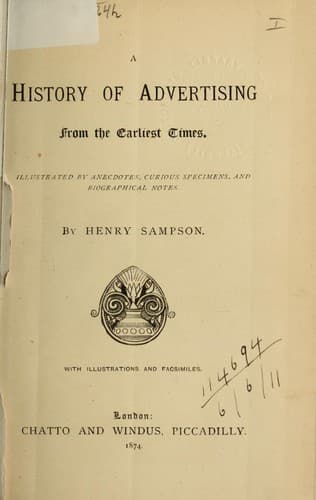
A History of Advertising from the Earliest Times.Sampson, Henry
History
A History of Advertising from the Earliest Times.
Sampson, Henry
Advertising -- History
“Lyckpenny” story is one of the few instances in English literature of
this early period, in which the custom of touting at shop doors is
distinctly mentioned, but, as before remarked, the French _fabliaux_
abound with such allusions. In the story of “Courtois d’Arras”--a
travestie of the Prodigal Son in a thirteenth-century garb--Courtois
finds the host standing at his door shouting, “Bon vin de Soissons, à
six deniers le lot.” And in a mediæval mystery entitled “Li Jus de S.
Nicolas,” the innkeeper, standing on the threshold, roars out, that in
his house excellent dinners are to be had, with warm bread and warm
herrings, and barrelfuls of Auxerre wine: “Céans il fait bon diner,
céans il y a pain chaud et harengs chauds, et vin d’Auxerre à plein
tonneau.” In the “Trois Aveugles de Compiègne,” the thirsty wanderers
hear mine host proclaiming in the street that he has “good, cool, and
new wine, from Auxerre and from Soissons; bread and meat, and wine and
fish: within is a good place to spend your money; within is
accommodation for all kind of people; here is good lodging:”--
Ci a bon vin fres et nouvel
Ça d’Auxerre, ça de Soissons,
Pain, et char, et vin, et poissons,
Céens fet bon despendre argent,
Ostel i a à toute gent
Céens fet moult bon heberger.
And in the “Débats et facétieuses rencontres de Gringald et de Guillot
Gorgen, son maistre,” the servant, who would not pay his reckoning,
excuses himself, saying, “The taverner is more to blame than I, for as I
passed before his door, and he being seated at it as usual, called to
me, saying, ‘Will you be pleased to breakfast here? I have good bread,
good wine, and good meat.’” “Le tavernier a plus de tort que moy; car,
passant devant sa porte, et luy étant assiz (ainsy qu’ils sont
ordinairement) il me cria, me disant: Vous plaist-il de dejeuner céans?
Il y a de bon pain, de bon vin, et de bonne viande.”
Other modes of advertising, of a less obtrusive nature, were, however,
in use at the same time; as in Rome, written handbills were affixed in
public places; and almost as soon as the art of printing was discovered,
it was applied to the purpose of multiplying advertisements of this
kind. We may fairly assume that one of the very first posters ever
printed in England was that by which Caxton announced, circa 1480, the
sale of the “Pyes of Salisbury use,”[18] at the Red Pole, in the
Almonry, Westminster. Of this first of broadsides two copies are still
extant, one in the Bodleian Library, at Oxford, the other in Earl
Spencer’s library. Their dimensions are five inches by seven, and their
contents as follows:--
^If it please ony man spirituel or temporel to bye our pyes of two or
thre comemoracio’s of Salisburi use, emprynted after the form of this
prese’t letre, whiche ben wel and truly correct, late hym come to
Westmonester, into the almonestrye at the reed pole and he shal haue
them good and chepe:^
^Supplico stet cedula.^
Public-domain text, read in full here on John Shaqi.
Reviews
Reviews
No reviews yet
Be the first to share your thoughts on this work.
Elsewhere in the archive
Join the Discussion
Join the discussion
Sign in to leave a comment or review.
Sign InorCreate an account