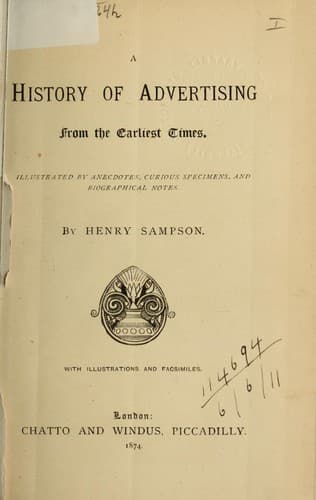
A History of Advertising from the Earliest Times.Sampson, Henry
History
A History of Advertising from the Earliest Times.
Sampson, Henry
Advertising -- History
Foreigners appear to have appreciated the boon of this kind of
advertising equally rapidly, although, from the fugitive nature of such
productions, copies of their posters are rarely to be found. Still an
interesting list of books, printed by Coburger at Nuremberg in the
fifteenth century, is preserved in the British Museum, to which is
attached the following heading: “Cupientes emere libros infra notatos
venient ad hospitium subnotatum,” &c.--_i.e._, “Those who wish to buy
the books hereunder mentioned, must come to the house now named,” &c.
The Parisian printers soon went a step further. Long before the
invention of the typographic art, the University had compelled the
booksellers to advertise in their shop windows any new manuscripts they
might obtain. But after the invention of printing they soon commenced to
proclaim the wonderful cheapness of the works they produced. It did not
strike them, however, that this might have been done effectually on a
large scale, and they were content to extol the low price of the work in
the book itself. Such notices as the following are common in early
books. Ulric Gering, in his “Corpus Juris Canonici,” 1500, allays the
fear of the public with a distich:--“Don’t run away on account of the
price,” he says. “Come rich and poor; this excellent work is sold for a
very small sum:”--
Ne fugite ob pretium: dives pauperque venite
Hoc opus excellens venditur ære brevi.
Berthold Remboldt subjoins to his edition of “S. Bruno on the Psalms,”
1509, the information that he does not lock away his wares (books) like
a miser, but that anybody can carry them away for very little money.
Istas Bertholdus merces non claudit avarus
Exiguis nummis has studiose geres.
And in his “Corpus Juris Canonici,” he boasts that this splendid volume
is to be had for a trifling sum, after having, with considerable labour,
been weeded of its misprints.
Hoc tibi præclarum modico patet ære volumen
Abstersum mendis non sine Marte suis.
Thielman Kerver, Jean Petit, and various other printers, give similar
intelligence to the purchasers of their works. Sometimes they even
resort to the process of having a book puffed on account of its
cheapness by editors or scholars of known eminence, who address the
public on behalf of the printer. Thus in a work termed by the French
savant Chevillier, “Les Opuscules du Docteur Almain,” printed by
Chevalon and Gourmont, 1518, a certain dignified member of the
University condescends to inform the public that they have to be
grateful to the publishers for the beautiful and cheap book they have
produced:--“Gratias agant Claudio Chevallon et Ægydio Gourmont, qui
pulchris typis et characteribus impressum opus hoc vili dant pretio.”
This, be it observed, is the earliest instance of the puff direct which
has so far been discovered.
Public-domain text, read in full here on John Shaqi.
Reviews
Reviews
No reviews yet
Be the first to share your thoughts on this work.
Elsewhere in the archive
Join the Discussion
Join the discussion
Sign in to leave a comment or review.
Sign InorCreate an account