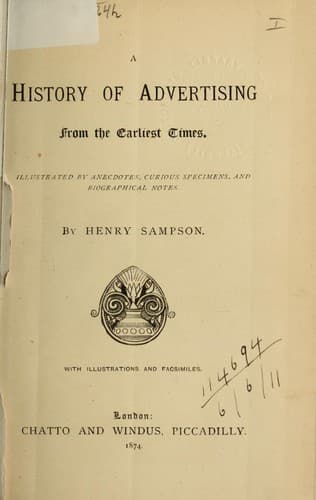
A History of Advertising from the Earliest Times.Sampson, Henry
History
A History of Advertising from the Earliest Times.
Sampson, Henry
Advertising -- History
Meanwhile, though the art of printing had become established, and was
daily taking more and more work out of the hands of scribes, writing
continued to be almost the only advertising media for wellnigh two
centuries longer. Like the ancient advertisement already noticed, that
of Venus about her runaway son, they commenced almost invariably with
the words “If anybody,” or, if in Latin, _Si quis_; and from these last
two words they obtained their name. They were posted in the most
frequented parts of the towns, preferably near churches; and hence has
survived the practice of attaching to church doors lists of voters and
various other notifications, particularly in villages. In the metropolis
one of the places used for this purpose may probably have been London
Stone. In “Pasquil and Marforius,” 1589, we read, “Set up this bill at
London Stone; let it be done solemnly with drum and trumpet;” and
further on in the same pamphlet, “If it please them, these dark winter
nights, to stick up these papers upon London Stone.” These two allusions
are, however, not particularly conclusive.
In the sixteenth and seventeenth centuries the principal place for
affixing a _siquis_ was in the middle aisle of St Paul’s. From the era
of the Reformation to the Restoration, all sorts of disorderly conduct
was practised in the old cathedral. A lengthy catalogue of improper
customs and disgusting practices might be collected from the works of
the period, and bills were stuck up in various parts to restrain the
grossest abuses. “At every door of this church,” says Weever, “was
anciently this vers depicted; and in my time [he died in 1632] it might
be perfectly read at the great south door, _Hic Locus sacer est, hic
nulli mingere fas est_.”
There were also within the sacred edifice tobacco, book, and sempstress’
shops; there was a pillar at which serving-men stood for hire, and
another place where lawyers had their regular stands, like merchants on
’Change. At the period when Decker wrote his curious “Gull’s Horn-Book”
(1609), and for many years after, the cathedral was the lounging place
for all idlers and hunters after news, as well as of men of almost
every profession, cheats, usurers, and knights of the post. The
cathedral was likewise a seat of traffic and negotiation, even pimps and
procuresses had their stations there; and the font itself, if credit may
be given to a black-letter tract on the “Detestable Use of Dice-play,”
printed early in Elizabeth’s reign, was made a place for the advance and
payment of loans, and the sealing of indentures and obligations for the
security of the moneys borrowed. Such a busy haunt was, of course, the
very best place for bills and advertisements to be posted.
Public-domain text, read in full here on John Shaqi.
Reviews
Reviews
No reviews yet
Be the first to share your thoughts on this work.
Elsewhere in the archive
Join the Discussion
Join the discussion
Sign in to leave a comment or review.
Sign InorCreate an account