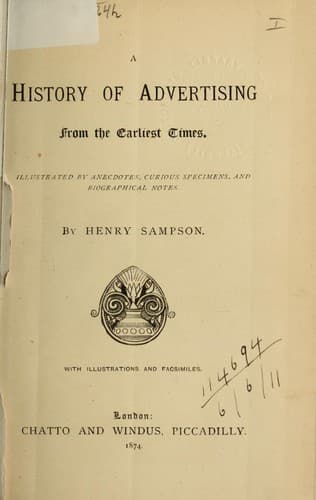
A History of Advertising from the Earliest Times.Sampson, Henry
History
A History of Advertising from the Earliest Times.
Sampson, Henry
Advertising -- History
No bonâ fide _siquis_ has come down to us, but it appears that among
them the applications for ecclesiastics were very common, as Bishop
Earle in his “Microcosmographia,” published in 1629, describes “Paul’s
Walke” as the “market of young lecturers, whom you may cheapen here at
all rates and sizes;” and this allusion is confirmed by a passage in
Bishop Hall’s “Satires” (B. ii. s. 5), in which also the custom of
affixing advertisements to a particular door is distinctly noticed:--
Saw’st thou ere _siquis_ patch’d on Paul’s church door
To seek some vacant vicarage before?
Who wants a churchman that can service say,
Read fast and fair his monthly homily,
And wed, and bury, and make cristen souls,
Come to the _left side alley_ of St Poule’s.
But the _siquis_ door was not confined to notices of ecclesiastical
matters; it was appropriated generally to the variety of applications
that is now to be found in the columns of a newspaper or the books of a
registry office. Though no authentic specimens of the _siquis_ remain,
we are possessed of several imitations, as the old dramatists delighted
in reproducing the inflated language of these documents. Thus, in
Holiday’s “Technogamia” (1618), Act i. scene 7, Geographus sets up the
following notice:--
If there be any gentleman that, for the accomplishing of his natural
endowment, intertaynes a desire of learning the languages; especially
the nimble French, maiestik Spanish, courtly Italian, masculine Dutch,
happily compounding Greek, mysticall Hebrew, and physicall Arabicke;
or that is otherwise transported with the admirable knowledge of
forraine policies, complimentall behaviour, naturall dispositions, or
whatsoever else belongs to any people or country under heaven; he
shall, to his abundant satisfaction, be made happy in his expectation
and successe if he please to repair to the signe of the Globe.
Again, Ben Jonson’s “Every Man out of his Humour” introduces Shift, “a
threadbare shark,” whose “profession is skeldring and odling, his bank
Paul’s.” Speaking of Shift in the opening scene of the third act, which
the dramatist has laid in “the middle aisle of Paules,” Cordatus says
that Shift is at that moment in Paules “for the advancement of a
_siquis_ or two, wherein he hath so varied himselfe, that if any one of
them take, he may hull up and doune in the humorous world a little
longer.” Shift’s productions deserved to succeed, as they were
masterpieces of their kind, and might even now, though the world is so
much older, and professes to be so much wiser, be studied with advantage
by gentlemen who cultivate the literature of advertisements in the
interest of certain firms. Here are some of his compositions, which
would certainly shine among the examples of the present day:--
Public-domain text, read in full here on John Shaqi.
Reviews
Reviews
No reviews yet
Be the first to share your thoughts on this work.
Elsewhere in the archive
Join the Discussion
Join the discussion
Sign in to leave a comment or review.
Sign InorCreate an account