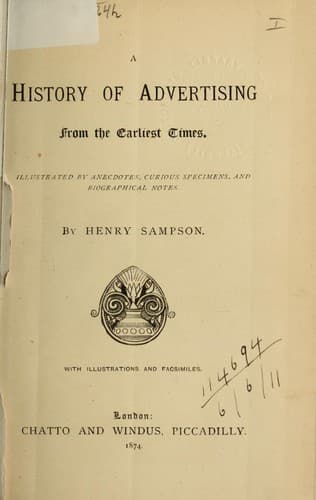
A History of Advertising from the Earliest Times.Sampson, Henry
History
A History of Advertising from the Earliest Times.
Sampson, Henry
Advertising -- History
If there be any lady or gentlewoman of good carriage that is desirous
to entertain to her private uses a young, straight, and upright
gentleman, of the age of five or six and twenty at the most; who can
serve in the nature of a gentleman usher, and hath little legs of
purpose,[19] and a black satin suit of his own to go before her in;
which suit, for the more sweetening, now lies in lavender;[20] and can
hide his face with her fan if need require, or sit in the cold at the
stair foot for her, as well as another gentleman; let her subscribe
her name and place, and diligent respect shall be given.
The following is even an improvement:--
If this city, or the suburbs of the same, do afford any young
gentleman of the first, second, or third head, more or less, whose
friends are but lately deceased, and whose lands are but new come into
his hands, that, to be as exactly qualified as the best of our
ordinary gallants are, is affected to entertain the most gentlemanlike
use of tobacco; as first to give it the most exquisite perfume; then
to know all the delicate, sweet forms for the assumption of it; as
also the rare corollary and practice of the Cuban ebolition, euripus
and whiff,[21] which we shall receive or take in here at London, and
evaporate at Uxbridge, or farther, if it please him. If there be any
such generous spirit, that is truly enamour’d of these good faculties;
may it please him but by a note of his hand to specify the place or
ordinary where he uses to eat and lie; and most sweet attendance with
tobacco and pipes of the best sort, shall be ministered. _Stet quæso,
candide lector._
It is noticeable that most of these advertisements commence with the
English equivalent for the Latin _si quis_, and furthermore that Ben
Jonson concludes with the same formula as Caxton, _stet quæso_,
imploring the “candid reader” not to tear off the bill. The word
_siquis_ is of frequent occurrence in the old writers. Green, for
instance, in his “Tu Quoque,” says of certain women that “they stand
like the devil’s _siquis_ at a tavern or alehouse door.” At present the
term has more particular reference to ecclesiastical matters. A
candidate for holy orders who has not been educated at the University,
or has been absent some time from thence, is still obliged to have his
intention proclaimed, by having a notice to that effect hung up in the
church of the place where he has recently resided. If, after a certain
time, no objection is made, a certificate of his _siquis_, signed by the
churchwardens, is given to him to be presented to the bishop when he
seeks ordination.
Public-domain text, read in full here on John Shaqi.
Reviews
Reviews
No reviews yet
Be the first to share your thoughts on this work.
Elsewhere in the archive
Join the Discussion
Join the discussion
Sign in to leave a comment or review.
Sign InorCreate an account