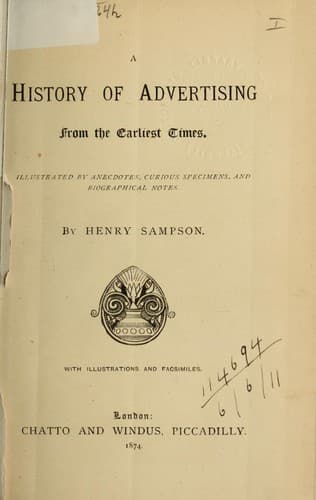
A History of Advertising from the Earliest Times.Sampson, Henry
History
A History of Advertising from the Earliest Times.
Sampson, Henry
Advertising -- History
At the time when the _siquis_ was the most common form of
advertisement, other methods were used in order to give publicity to
certain events. There were the proclamations of the will of the King,
and of the Lord Mayor, whose edicts were proclaimed by the common
trumpeter. There were also two richly carved and gilt posts at the door
of the Sheriff’s office,[22] on which (some annotators of old plays say)
it was customary to stick enactments of the Town Council. The common
crier further made known matters of minor and commercial importance, and
every shopkeeper still kept an apprentice at his door to attract the
attention of the passers-by with a continuous “What do you lack,
master?” or “mistress,” followed by a voluble enumeration of the wares
vended by his master. The bookseller, as in ancient Rome, still
advertised his new works by placards posted against his shop, or fixed
in cleft sticks. This we gather from an epigram of Ben Jonson to his
bookseller, in which he enjoins him rather to sell his works to
Bucklersbury, to be used for wrappers and bags, than to force their sale
by the usual means:--
Nor have my little leaf on post or walls,
Or in cleft sticks advancèd to make calls
For termers or some clerk-like serving-man.
Announcements of shows were given in the manner still followed by the
equestrian circus troops in provincial towns, viz., by means of bills
and processions. Thus notice of bearbaitings was given by the bears
being led about the town, preceded by a flag and some noisy instruments.
In the Duke of Newcastle’s play of “The Humorous Lovers” (1677), the
sham bearward says, “I’ll set up my bills, that the gamesters of London,
Horseleydown, Southwark, and Newmarket, may come in and bait him before
the ladies. But first, boy, go, fetch me a bagpipe; we will walk the
streets in triumph, and give the people notice of our sport.” Such a
procession was, of course, a noisy one, and for that reason it was one
of the plagues the mischievous page sent to torment Morose, “the
gentleman that loves no noise,” in Ben Jonson’s “Silent Woman.” “I
entreated a bearward one day,” says the page, “to come down with the
dogs of some four parishes that way, and I thank him he did, and cried
his game under Master Morose’s window.” And in Howard’s “English
Monsieur” (1674), William, a country youth, says, “I saw two
rough-haired things led by the nose with two strings, and a bull like
ours in the country, with a brave garland about his head, and an horse,
and the least gentleman upon him that ever I saw in my life, and brave
bagpipes playing before ’um;” which is explained by Comely as occasioned
by its being “bearbaiting day, and he has met with the bull, and the
bears, and the jack-an-apes on horseback.” Trials of skill in the noble
art of self-defence were announced in a similar manner, by the
combatants promenading the streets divested of their upper garments,
with their sleeves tucked up, sword or cudgel in hand, and preceded by a
Public-domain text, read in full here on John Shaqi.
Reviews
Reviews
No reviews yet
Be the first to share your thoughts on this work.
Elsewhere in the archive
Join the Discussion
Join the discussion
Sign in to leave a comment or review.
Sign InorCreate an account