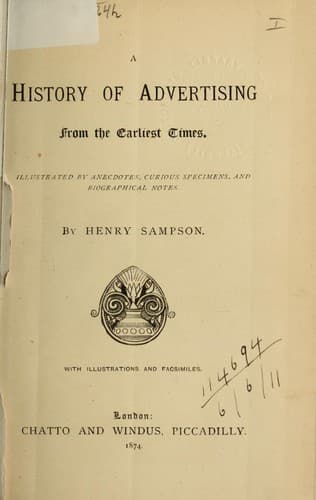
A History of Advertising from the Earliest Times.Sampson, Henry
History
A History of Advertising from the Earliest Times.
Sampson, Henry
Advertising -- History
Sir Walter Scott, in one of his notes, gives a quaint specimen of vocal
advertising. In the old days of Scotland, when persons of property
(unless they happened to be nonjurors) were as regular as their
inferiors in attendance on parochial worship, there was a kind of
etiquette in waiting till the patron, or acknowledged great man of the
parish, should make his appearance. This ceremonial was so sacred in the
eyes of a parish beadle in the Isle of Bute, that the kirk bell being
out of order, he is said to have mounted the steeple every Sunday to
imitate with his voice the successive summonses which its mouth of metal
used to send forth. The first part of this imitative harmony was simply
the repetition of the words, “Bell, bell, bell, bell!” two or three
times, in a manner as much resembling the sound as throat of flesh could
imitate throat of iron. “Bellùm, Bellùm!” was sounded forth in a more
urgent manner; but he never sent forth the third and conclusive peal,
the varied tone of which is called in Scotland the “ringing-in,” until
the two principal heritors of the parish approached, when the chime ran
thus--
Bellùm Bellèllum,
Bernera and Knockdow’s coming!
Bellùm Bellèllum,
Bernera and Knockdow’s coming!
A story is also told of an old Welsh beadle, who, having no bell to his
church, or the bell being out of order, used to mount the tower before
the service on Sundays, and advertise the fact that they were just about
to begin, in imitation of the chimes, and in compliment to the most
conspicuous patronymics in the congregation list, thus--
Shon Morgan, Shon Shones,
Shon Shenkin, Shon Morgan, Shon Shenkin,
Shon Shones!
Continued _à discretion_. And with this most singular form of vocal
advertising we will conclude the chapter.
[14] Glossary, cap. xxvii. “Wine-criers cry with open mouth the wine
which is for sale in the taverns at four farthings.”
[15] Chronicles of the Monk Alberic des Trois Fontaines, under the
year 1235.
[16] All around here they cry wine at the rate
Of thirty-two, sixteen, twelve, six, and eight.
[17] To name the other cries our time would waste--
They cry old wine and new, and bid you taste.
[18] No savoury meat-pies, as some gastronomic reader might think,
since they came from the county of sausage celebrity, but a collection
of rules, as practised in the diocese of Salisbury, to show the
priests how to deal, under every possible variation in Easter, with
the concurrence of more than one office on the same day. These rules
varied in the different dioceses.
[19] Small calveless legs are mentioned as characteristic of a
gentleman in many of our old plays, and will be observed in most
full-length portraits of the sixteenth and seventeenth century.
[20] To “lie in lavender” was a cant term for being in pawn.
Public-domain text, read in full here on John Shaqi.
Reviews
Reviews
No reviews yet
Be the first to share your thoughts on this work.
Elsewhere in the archive
Join the Discussion
Join the discussion
Sign in to leave a comment or review.
Sign InorCreate an account