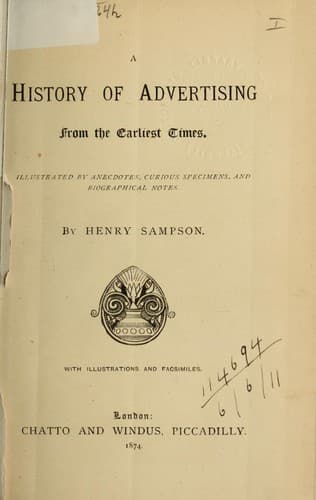
A History of Advertising from the Earliest Times.Sampson, Henry
History
A History of Advertising from the Earliest Times.
Sampson, Henry
Advertising -- History
drum. Finally, for the use of the community at large, there was the
bellman or town crier, a character which occupies a prominent place in
all the old sets of “Cries of London.” In one of the earliest
collections of that kind,[23] engraved early in the seventeenth century,
we see him represented with a bunch of keys in his hand, which he no
doubt proclaims as “found.” Underneath is the following “notice:”--
O yes. Any man or woman that
Can tell any tidings of a little
Mayden-childe of the age of 24
Yeares. Bring word to the cryar
And you shall be pleased for your labour
And God’s blessing.
This was an old joke, which, more or less varied, occurs always under
the print of the town crier. The prototype of this venerable witticism
may be found in the tragedy of “Soliman and Perseda” (1599), where one
of the characters says that he
------ had but sixpence
For crying a little wench of thirty yeeres old and upwardes,
That had lost herself betwixt a taverne and a b----y house.
Notwithstanding the immense development of advertising since the spread
of newspapers, the services of the bellman are still used in most of the
country towns of the United Kingdom, and even in London there are still
bellmen and parish criers, though their offices would appear to be
sinecures. The provincial crier’s duties are of the most various
description, and relate to objects lost or found, sales by public
auction or private contract, weddings, christenings, and funerals. Not
much more than a century ago the burgh of Lanark was so poor that there
was in it only one butcher, and even he dared never venture on killing a
sheep till every part of the animal was ordered beforehand. When he felt
disposed to engage in such an enterprise, he usually prevailed upon the
minister, the provost, and the members of the town council to take a
joint each; but when shares were not subscribed for readily, the sheep
received a respite. On such occasion the services of the bellman, or
“skelligman,” as he was there named, were called into request, and that
official used to perambulate the streets of Lanark acquainting the
lieges with the butcher’s intentions in the following rhyme:--
Bell-ell-ell!
There’s a fat sheep to kill!
A leg for the provost,
Another for the priest,
The bailies and the deacons
They’ll tak’ the neist;
And if the fourth leg we canna sell,
The sheep it maun leeve, and gae back to the hill!
Public-domain text, read in full here on John Shaqi.
Reviews
Reviews
No reviews yet
Be the first to share your thoughts on this work.
Elsewhere in the archive
Join the Discussion
Join the discussion
Sign in to leave a comment or review.
Sign InorCreate an account