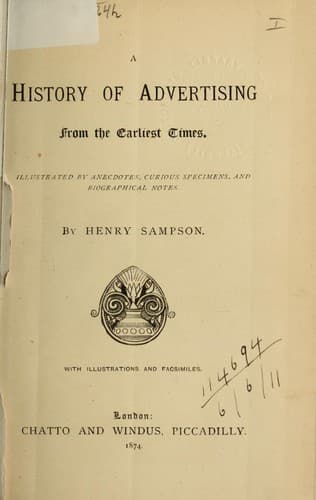
A History of Advertising from the Earliest Times.Sampson, Henry
History
A History of Advertising from the Earliest Times.
Sampson, Henry
Advertising -- History
necessarily have entered new premises or erected extempore shops, yet
hardly any announcements appear in the papers to acquaint the public of
the new addresses. The _London Gazette_, October 11-15, 1666, offered
its services, but hardly to any effect; little regard being paid to the
following invitation:--
Such as have settled in new habitations since the late fire, and
desire for the convenience of their correspondence to publish the
place of their present abode, or to give notice of goods lost or
found, may repair to the corner house in Bloomsbury, or on the east
side of the great square [Bloomsbury Square] before the house of the
Right Honourable the Lord Treasurer, where there is care taken for the
receipt and publication of such advertisements.
Among the very few advertisements relating to those great calamities is
the following, produced by the Plague, which is inserted in the
_Intelligencer_, June 22-30, 1665:--
THIS is to certify that the master of the Cock and Bottle, commonly
called the Cock alehouse, at Temple bar, hath dismissed his servants,
and shut up his house for this long vacation, intending (God willing)
to return at Michaelmas next, so that all persons who have any
accounts or farthings belonging to the said house, are desired to
repair thither before the 8th of this instant, July, and they shall
receive satisfaction.
Relating to the Fire, the following from the _London Gazette_, March 12,
1672-73, was the notification:--
THESE are to give notice that Edward Barlet, Oxford carrier, hath
removed his Inn in London from the Swan at Holborn Bridge to the
Oxford Arms in Warwick Lane, where he did inne before the Fire. His
coaches and waggons going forth on their usual days, Mondays,
Wednesdays, and Fridays. He hath also a hearse, with all things
convenient to carry a corpse to any part of England.
There is not, however, a single advertisement relating to any of those
temporary conveniences of every kind which invariably arise, as by
magic, on any great and unusual emergency. Indeed, about this period,
and for a long time after, the _London Gazette_, which was the official
organ of the day, appeared frequently without a single advertisement;
and till the end of the reign of Charles II., it was only very rarely
that that paper contained more than four advertisements of a general
kind, very frequently the number being less. The subjects of these were
almost exclusively thefts, losses, and runaways. Booksellers’ and
quacks’ advertisements were, however, even then frequent in this paper;
their announcements always preceded the others, and were printed in a
different type.
Public-domain text, read in full here on John Shaqi.
Reviews
Reviews
No reviews yet
Be the first to share your thoughts on this work.
Elsewhere in the archive
Join the Discussion
Join the discussion
Sign in to leave a comment or review.
Sign InorCreate an account