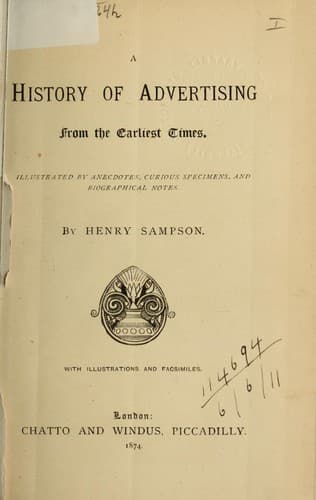
A History of Advertising from the Earliest Times.Sampson, Henry
History
A History of Advertising from the Earliest Times.
Sampson, Henry
Advertising -- History
Conciseness was of course necessary when it is recollected that the
paper was only a folio half-sheet, though the news was so scanty that
the few advertisements were a boon to the reader, and were sure to be
read. This was an advantage peculiar to the early advertisers. So long
as the papers were small, and the advertisements few in number, the
trade announcements were almost more interesting than the news. But when
the papers increased in bulk, and advertisements became common, it
behoved those who wished to attract special attention to resort to
contrivances which would distinguish them from the surrounding crowd of
competitors.
The editor of the _London Mercury_, in 1681, evidently with an eye to
making his paper a property on the best of all principles, requests all
those who have houses for sale to advertise in his columns, “where,”
says he, “farther care will be taken for their disposal than the bare
publishing them, by persons who make it their business.” Consequently we
frequently meet in this paper with notices of “A delicate House to
lett,” agreeably varied with advertisements concerning spruce beer,
scurvy grass, Daffy’s elixir, and other specifics. Notwithstanding that
the utility of advertising as a means of obtaining publicity was as yet
hardly understood, the form of an advertisement, according to modern
plans, was, it is curious to observe, frequently adopted at this period
to expose sentiments in a veiled manner, or to call attention to public
grievances. Thus, for instance, the first numbers of the _Heraclitus
Ridens_, published in 1681, during the effervescence of the Popish
plots, contained almost daily one or more of these political satires, of
which the following may serve as examples. The first appears February 4.
IF any person out of natural curiosity desire to be furnished with
ships or castles in the air, or any sorts of prodigies, apparitions,
or strange sights, the better to fright people out of their senses,
and by persuading them there are strange judgments, changes, and
revolutions hanging over their heads, thereby to persuade them to pull
them down by discontents, fears, jealousies, and seditions; let them
repair to Ben Harris, at his shop near the Royal Exchange, where they
may be furnished with all sorts and sizes of them, at very cheap and
easy rates.
There is also to be seen the strange egg with the comet in it which
was laid at Rome, but sent from his Holiness to the said Ben, to make
reparations for his damages sustained, and as a mark of esteem for his
zeal and sufferings in promoting discord among the English hereticks,
and sowing the seeds of sedition among the citizens of London.
The edition of February 15 contains the following:--
Public-domain text, read in full here on John Shaqi.
Reviews
Reviews
No reviews yet
Be the first to share your thoughts on this work.
Elsewhere in the archive
Join the Discussion
Join the discussion
Sign in to leave a comment or review.
Sign InorCreate an account